
Is It ‘Bad Behavior’ or a Stressed Nervous System? Understanding Your Child’s Signals
If we were sitting together with coffee talking about your kids, this is one of the things I’d probably bring up gently—because so many parents are seeing it, and most of them feel a little alone in it.
Kids don’t have jobs or bills or email… but that absolutely does not mean they aren’t stressed. Their stress just shows up differently than ours.
They don’t say, “I’m feeling really dysregulated today.”
They say it with their bodies and their behavior.
For a lot of kiddos, stress looks like:
more meltdowns or mood swings
trouble falling or staying asleep
random tummy aches (especially before school or activities)
extra clinginess, restlessness, or “acting out for no reason”
Sound familiar?
Their nervous systems are still learning how to handle big feelings, busy days, loud environments, new situations—and yes, even the stress they pick up from us without us saying a word. So something that feels “small” to an adult—a schedule change, a busy week, a new teacher, a parent traveling—can feel really big in their little bodies.
When their system gets overloaded, it’s not just emotions that feel off. Their nervous system is in charge of things like digestion, sleep, mood, and immune function. So when it’s stuck in “on” mode, all of those things can start to wobble at the same time:
They’re not sleeping great.
They’re more reactive.
They don’t feel good, but you can’t quite put your finger on why.
You start getting the “my belly hurts” conversation a lot more often.
And as a parent, it’s easy to go straight to, “What am I doing wrong?” or “Why are they like this all of a sudden?” Please hear me: you’re not failing and your child isn’t broken. Their nervous system is just doing its best to keep up with a lot.
This is where gentle, nervous-system-focused chiropractic care for kids comes in.
With little ones, adjustments are very gentle—think light pressure, not big twists or cracks. The goal isn’t to “fix” their behavior. The goal is to help their spine and nervous system move and function better so their brain and body can talk to each other more clearly.
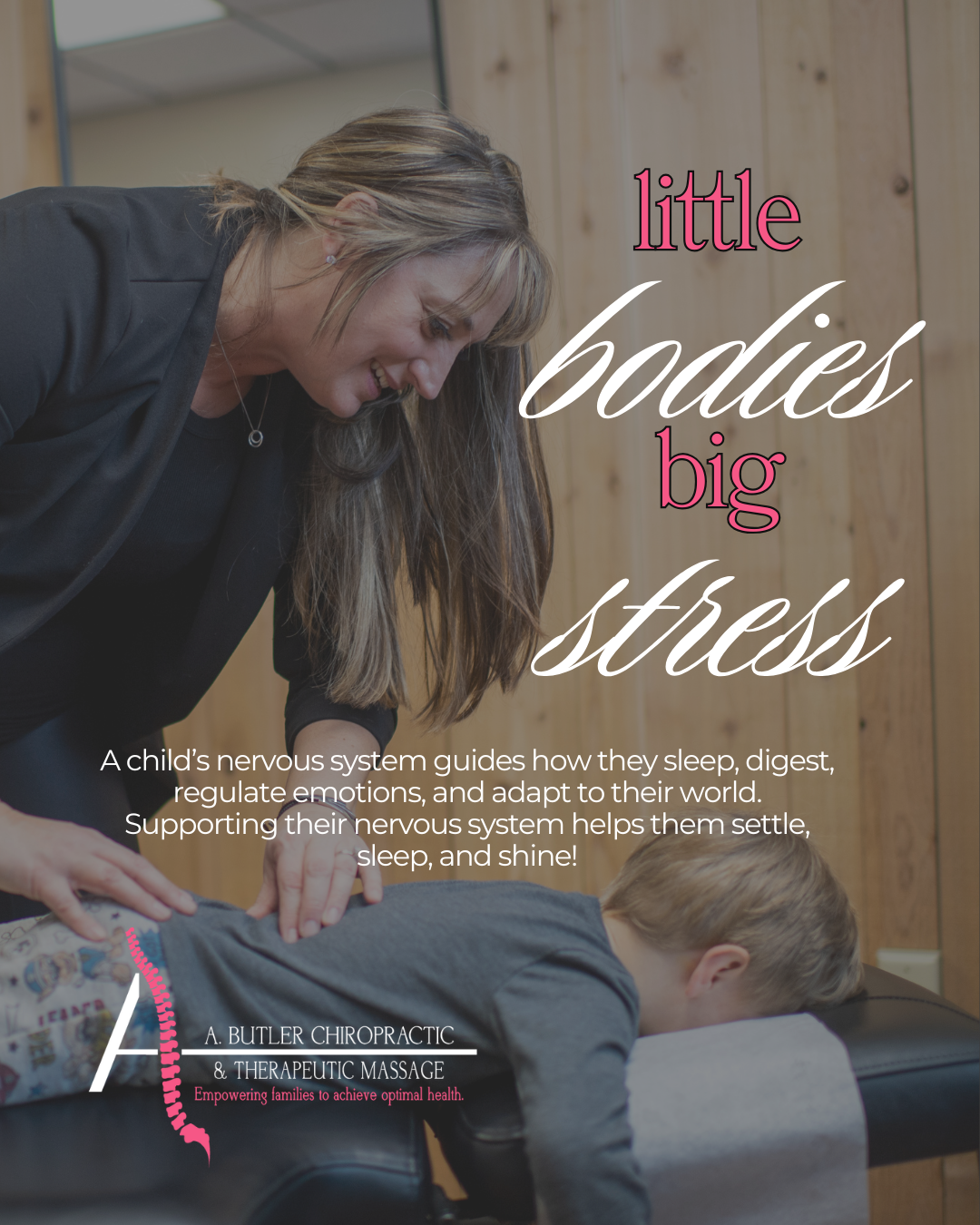
When that communication is clearer, kids’ bodies often feel safer and more organized on the inside. And when that happens, parents tend to notice things like:
they sleep more deeply
tummy aches aren’t popping up as often
mornings aren’t quite as explosive
they seem calmer and a little more like themselves
It’s not that chiropractic magically makes life easy; it just helps take some of the constant stress load off their system so they have more capacity to handle what’s already on their plate.
For older kids and teens, especially those in sports or who carry tension in their shoulders, neck, or low back, massage can also be a really nice piece of the puzzle. Tight, overworked muscles feed into a stressed nervous system, and a stressed nervous system feeds into tight, overworked muscles—it goes both ways. When we work on both the nervous system and the muscles, their body doesn’t feel like it has to stay on guard all the time.
And just so you know: if your child is struggling right now, that does not mean you’re a bad parent.
It doesn’t mean you didn’t do enough.
It doesn’t mean they’re “too sensitive.”
It just means their system needs support in a world that asks a lot of them.
In our office, my goal isn’t to label your child or make you feel judged. It’s to help their body feel safer, calmer, and more capable of doing what it’s designed to do—sleep, digest, heal, regulate, and handle big feelings a little more easily.
If all of this sounds like your house lately, you are so not alone—and you don’t have to figure it out by yourself.
At A. Butler Chiropractic, we offer gentle pediatric chiropractic care (and massage for older kids/teens when it’s appropriate) to support your child’s nervous system in a way that’s safe and age-appropriate.
If you’re curious about whether this might help your kiddo:
You can book a visit online HERE, or call 724-822-1828 and we’ll help you figure out the best place to start.
Your child doesn’t need to “toughen up.” They need support for the nervous system they’re growing up in. And that’s exactly what we’re here for.