
When Life Gets Busy… Does Your Low Back Start Yelling First?
If your low back always seems to act up the minute life gets busy—packed schedules, long days, big emotions—you are not being dramatic, and you’re definitely not the only one.
I hear some version of this all the time in the office: “My back always goes out when I’m stressed.” “Every time things get hectic, my low back is the first thing to complain.”
Honestly? That checks out.
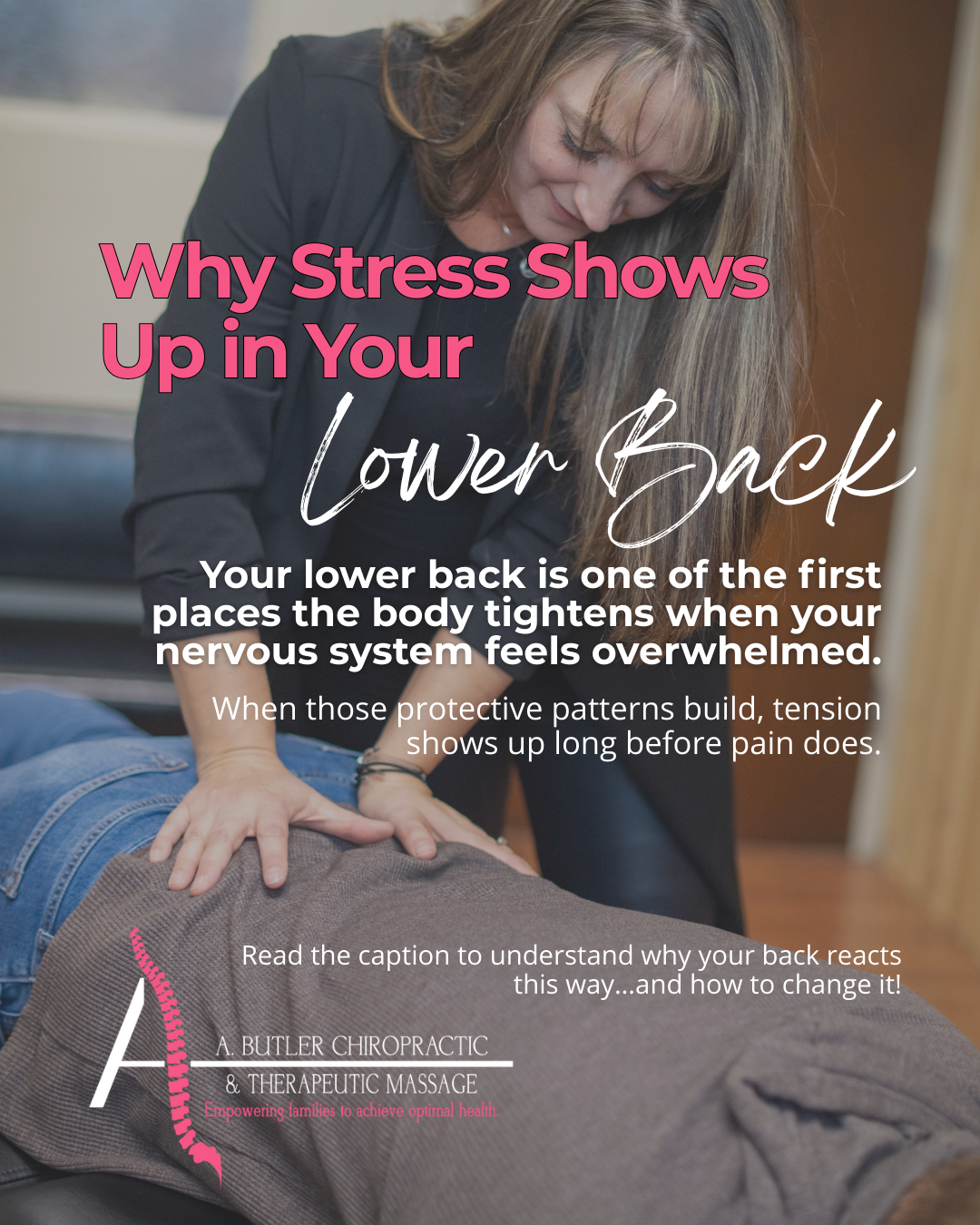
Your low back is one of the main places stress loves to land.
Why Your Low Back and Stress Are So Connected
Let’s make this simple.
Your body has a built-in “protect mode.” When you’re under stress—physical (lifting, sitting, driving), emotional (worry, grief, overwhelm), or mental (deadlines, decision fatigue)—your nervous system doesn’t sort it into categories. It just thinks: “We’ve got a lot going on. Better brace.”
And one of the easiest ways for your body to brace is by tightening the muscles around your spine and pelvis, especially in your low back. If that “brace mode” sticks around for a while, it can start to feel like:
constant tightness or a “compressed” feeling
stiffness getting out of bed in the morning
feeling like you have to guard every time you bend, lift, or twist
never quite getting comfortable, even when you finally sit or lie down
That doesn’t mean your back is weak, broken, or “going out” all the time.
Most of the time, it means your nervous system has been in survival mode for longer than it wants to be, and your low back is taking the hit.
What’s Actually Going On in Your Body (In Plain English)
Here’s the quick, slightly nerdy version, without the textbook:
Stress hormones (like cortisol and adrenaline) go up.
Your nervous system leans more into fight / flight / freeze.
Muscle tone increases, especially in big supportive areas: spine, hips, shoulders.
Your body focuses more on “get through today” and less on long-term repair.
If that only happens once in a while, your body usually resets on its own.
But if you’ve been living in that state for weeks, months, or honestly… years?
Your low back never truly gets the “you can relax now” message. It just keeps bracing.
Eventually it speaks up the only way it knows how: pain, stiffness, tension, and that “if I move wrong, I’m done” feeling.
Why Chiropractic + Massage Work So Well Together
This is where nervous-system-focused chiropractic care and massage make a really good team.
What chiropractic is doing
With chiropractic, I’m looking at:
how your spine and pelvis are moving (or not moving)
where joints are stuck or overworking
how clearly your nervous system is communicating with your body
Gentle, specific adjustments help:
take extra stress off those joints
improve motion through the spine and hips
support better brain–body communication
When your nervous system feels less “on alert,” it doesn’t need to use your low back as a full-time shield. That alone can turn the volume down on pain and tension.
What massage is doing
Massage then works on the muscles and fascia that have been gripping for dear life.
Hands-on work helps:
increase blood flow to tight, tired areas
soften those stubborn knots and protective patterns
send a “hey, we’re safe now” message back to your nervous system
So chiropractic is helping from the inside out, and massage is helping from the outside in. When we put those together, your body doesn’t feel like it has to stay locked up all the time.
That’s usually when people start telling me things like:
“I’m not as stiff in the morning.”
“I can bend and lift without panicking.”
“I still get tired, but my back doesn’t scream at me like it used to.”
It’s Not Just About the Worst Days
A lot of people only come in when it’s really bad—the “I can barely move” days.
Yes, we absolutely want to help you through those moments.
But long term, your low back does better if we support it before it hits full meltdown.
Seeing chiropractic and massage as regular support instead of “emergency only” care helps your body:
adapt better during busy seasons
recover faster between stressful stretches
feel more stable so every little thing isn’t the thing that takes you out
You don’t have to live in fear of “the next time my back goes out.”
When Is It Time to Reach Out?
Here are some gentle red flags your body might be waving:
your low back is grumbling more days than not
it always flares when things are emotionally or mentally heavy
you’re moving differently to avoid pain (guarding, bracing, babying it)
mornings are getting stiffer and slower
you’re just tired of feeling like your back is running the show
You don’t have to wait until you’re stuck on the couch or hunched over the sink in tears.
You’re Not Broken (And You Don’t Have to Just Live With It)
If this sounds a little too familiar, please know:
you’re not imagining it
it’s not “all in your head”
you’re not stuck like this forever
Your low back is often one of the first places stress shows up— and one of the first places we see change when your nervous system finally gets some support.
At A. Butler Chiropractic, we use chiropractic and massage together to help calm your system, ease tension, and make day-to-day life feel easier in your body.
If you’re ready for some help with that “busy-season back,” you can:
book chiropractic and massage online HERE, or
call 724-822-1828 and we’ll help you find a time that actually fits your real life.
Your back has been carrying a lot for a long time. You don’t have to keep doing it alone.