
Why We Look Deeper Than “Where Does It Hurt?”
Have you ever left an appointment feeling like…
“Okay, but I still don’t feel like anyone really understood what I’m feeling?”
You explained your symptoms.
You told them where it hurts.
You tried to describe the tightness, the pressure, the exhaustion, the “something just feels off” feeling.
And still… it felt like the whole story wasn’t really heard.
If that’s you, you’re not alone.
So many people come into our office after spending months, sometimes even years, feeling like their body is trying to tell them something. Maybe they’ve been told everything looks “fine.” Maybe their symptoms don’t fit neatly into one box. Maybe they’ve tried stretching, resting, adjusting their posture, changing pillows, taking supplements, or just pushing through.
But their body still doesn’t feel like itself. That’s exactly why we do things differently here.
We Don’t Just Ask, “Where Does It Hurt?”
Of course, where you feel pain matters. But it’s not the only thing that matters. Pain, tension, poor sleep, headaches, digestive stress, constant tightness, difficulty settling, and that “always on edge” feeling can all be clues. They’re pieces of a bigger picture.
So instead of only asking, “Where does it hurt?” we ask questions like:
What has your body been adapting to?
How long has this pattern been building?
What does your stress load look like?
How are you sleeping?
How is your body moving day to day?
Is your nervous system stuck in protection mode?
Are your muscles guarding because something underneath isn’t moving well?
Because the body rarely works in isolated pieces. Your neck tension may be connected to your breathing. Your low back pain may be connected to your hips or pelvis. Your headaches may be connected to your upper neck. Your child’s sleep struggles or big emotions may be connected to how their nervous system is adapting.
That doesn’t mean every symptom has one simple answer. It means your body deserves to be looked at as a whole.
Why This Matters for Real Life
Most people aren’t living in perfect conditions.
You’re working.
Parenting.
Driving.
Carrying bags, kids, stress, and mental load.
Sleeping in weird positions.
Sitting at a desk.
Scrolling on your phone.
Recovering from pregnancy or postpartum.
Trying to keep everyone else okay.
Your body is responding to all of that. And sometimes the symptoms you feel are not random. They are your body’s way of saying, “Hey, I’m working really hard to keep up.” That’s why a one-size-fits-all approach doesn’t always work.
You are not just a spine.
You are not just a tight muscle.
You are not just a headache, a hip, a shoulder, or a low back.
You are a whole person with a nervous system, habits, stress patterns, posture patterns, movement patterns, and a real life happening around you.
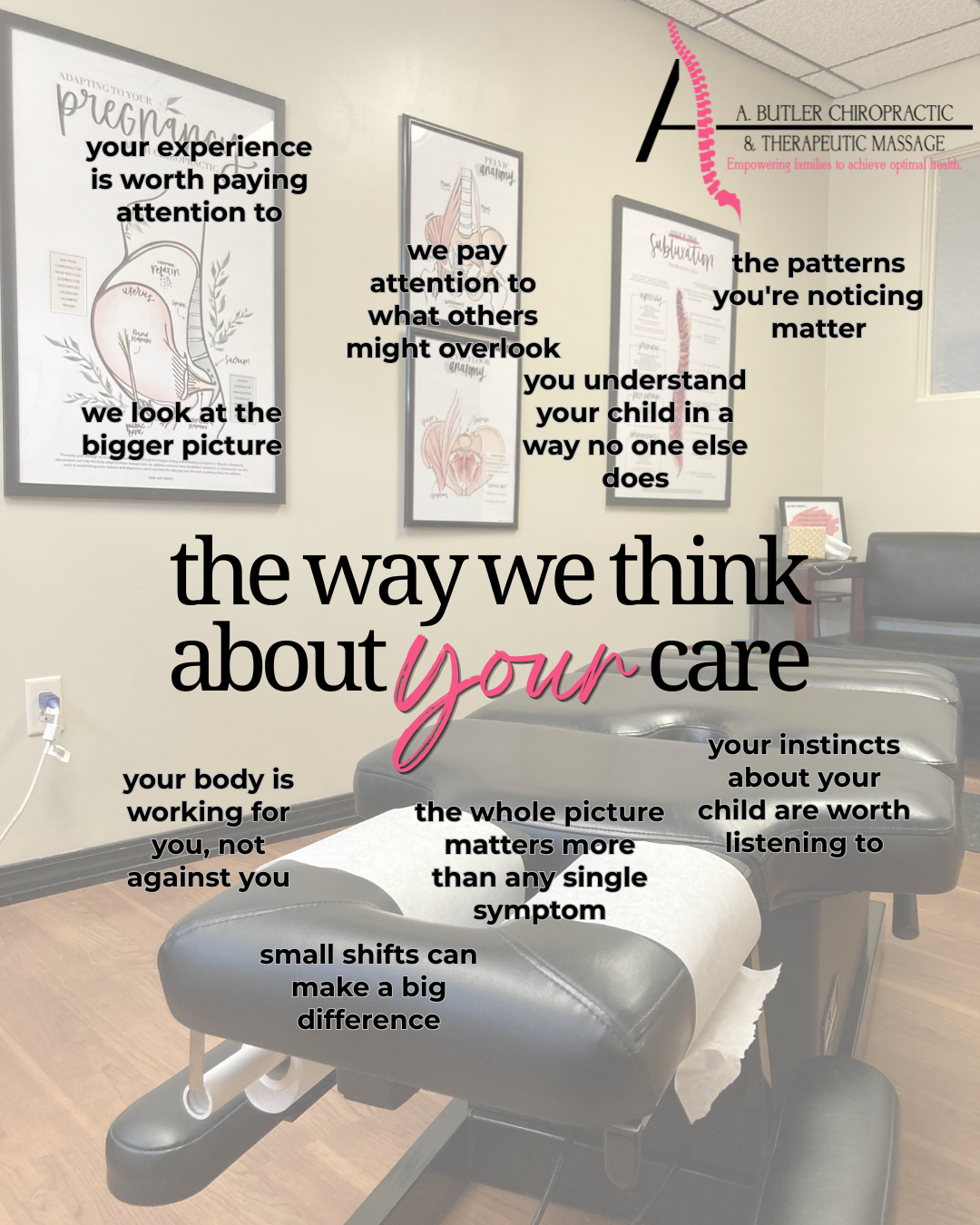
What Makes Our Care Different?
We love chiropractic care.
But we also know that “just getting adjusted” isn’t always the full answer.
For some people, an adjustment brings relief, but the same tension keeps coming back. For others, the pain improves for a little while, but the pattern underneath is still there. And for some, their body is so guarded or stressed that it needs more support before it can actually hold change. That’s why our care looks at more than alignment alone.
We look at:
Joint motion
Muscle tension
Nervous system stress
Posture and movement habits
Compensation patterns
Pregnancy and postpartum changes
Pediatric development and regulation
Lifestyle factors that may be adding stress to the system
Then we build care around what your body is actually asking for.
Sometimes that means chiropractic adjustments.
Sometimes that means soft tissue work.
Sometimes that means nervous system support.
Sometimes that means movement, breathing, massage, red light, PEMF, or helping you understand the patterns your body has been stuck in.
It’s not about doing more just to do more. It’s about doing the right things for your body.
Why We Focus So Much on the Nervous System
Your nervous system is your body’s communication center. It helps coordinate movement, healing, sleep, digestion, stress response, muscle tone, and how safe or guarded your body feels.
When your nervous system is under stress for a long time, your body may start living in a more protective state. Muscles tighten. Breathing gets shallow. Sleep can feel less restful. Your body may feel tense even when you’re trying to relax.
This is why we talk so much about helping your body shift out of “brace and survive” mode. Because when your body feels safer and more supported, it can often move, heal, and function with more ease. That’s the difference between chasing symptoms and supporting the system behind them.
And Yes, This Matters for Kids Too
Kids have nervous systems too. And sometimes what looks like “behavior” may actually be a child’s body asking for more support.
Big emotions.
Trouble settling.
Sleep struggles.
Difficulty relaxing.
Always being “on the go.”
Sensitivity to transitions.
Struggling to calm after getting upset.
Of course, kids are kids. Big feelings and hard days are part of growing up. But when patterns keep showing up, it can be helpful to look at how their nervous system is adapting.
Pediatric chiropractic care in our office is gentle, specific, and focused on supporting function. We are not here to label your child or force them into a box. We are here to listen, observe, and support their body in a way that feels safe and appropriate for them.
Sometimes a child doesn’t need someone to say, “They’re just difficult.” Sometimes they need someone to ask, “What is their body trying to communicate?”
Why Clients Feel the Difference
When someone feels truly heard, care changes.
They stop feeling like they have to prove that something is wrong.
They start understanding why their body feels the way it does.
They feel more involved in the process.
They begin to connect the dots.
Research on patient-centered care supports the importance of listening, communication, shared decision-making, and understanding the person beyond the diagnosis. And honestly, that’s what we see every day in practice. People don’t just want a quick fix. They want someone to slow down long enough to understand what they’re experiencing. They want a plan that makes sense. They want to know why the same pain, tension, or stress pattern keeps coming back. And they want care that supports their real life, not just a textbook version of health.
You Don’t Have to Fit Into a One-Size-Fits-All Plan
Your care should not feel rushed. It should not feel like you’re being squeezed into the same plan as everyone else. And it definitely should not feel like your concerns are being brushed off just because they don’t fit perfectly into one category.
At A. Butler Chiropractic, our goal is to help you understand your body better.
We want to know what you’re feeling.
We want to know what’s been going on.
We want to know what your day-to-day life looks like.
We want to know what your body has been carrying.
Then we help you connect the dots.
And that’s exactly what we’re here for.
More Than Just Chiropractic Care
Chiropractic care is a big part of what we do. But our approach is bigger than “come in, get adjusted, and leave.”
We want you to feel cared for.
We want your nervous system supported.
We want your muscles, joints, movement, and stress patterns considered.
We want your family to feel seen.
We want your care to make sense for your season of life.
Whether you’re pregnant, postpartum, raising little ones, dealing with chronic tension, navigating headaches, trying to sleep better, or just feeling like something is off, you deserve care that looks at the full picture. Because when we understand the why behind what you’re feeling, we can support your body in a much more meaningful way.
Feeling Like Something Is Missing?
If you’ve been feeling like no one has really connected the dots for you yet, we’d love to help.
You don’t have to keep wondering if it’s “all in your head.”
You don’t have to keep pushing through symptoms that keep coming back.
You don’t have to settle for care that only looks at one piece of the puzzle.
Your body is communicating. Let’s listen to it together. Book your appointment HERE with A. Butler Chiropractic and let’s figure out what your body is really asking for.