
Upper Trap Tension: Why Your Neck and Shoulders Feel So Tight
Ever feel like your shoulders are living up by your ears? Like no matter how many times you roll them back, stretch your neck, or rub that one tight spot… they just creep right back up again?
Let’s talk about your upper traps.
Your upper traps, or upper trapezius muscles, are the muscles that run from the base of your skull, down your neck, and out toward your shoulders. They help with neck movement, shoulder movement, posture, and supporting your head.
But when they get tight, overworked, or stuck in that “on guard” position, they can cause a lot more than just shoulder tension.
And honestly? This is one of the most common things we see in the office.
What Upper Trap Tension Can Feel Like
Upper trap tension can show up in a few different ways, and sometimes people do not even realize these symptoms are connected.
You may notice:
• Neck pain and stiffness
• Shoulder tightness
• Tension headaches
• Pain into the upper back
• Limited range of motion
• That heavy, tight, stressed feeling through your shoulders
• Feeling like you constantly need to stretch or massage the area
Sometimes it feels like a knot. Sometimes it feels like pressure. Sometimes it feels like your shoulders just cannot relax.
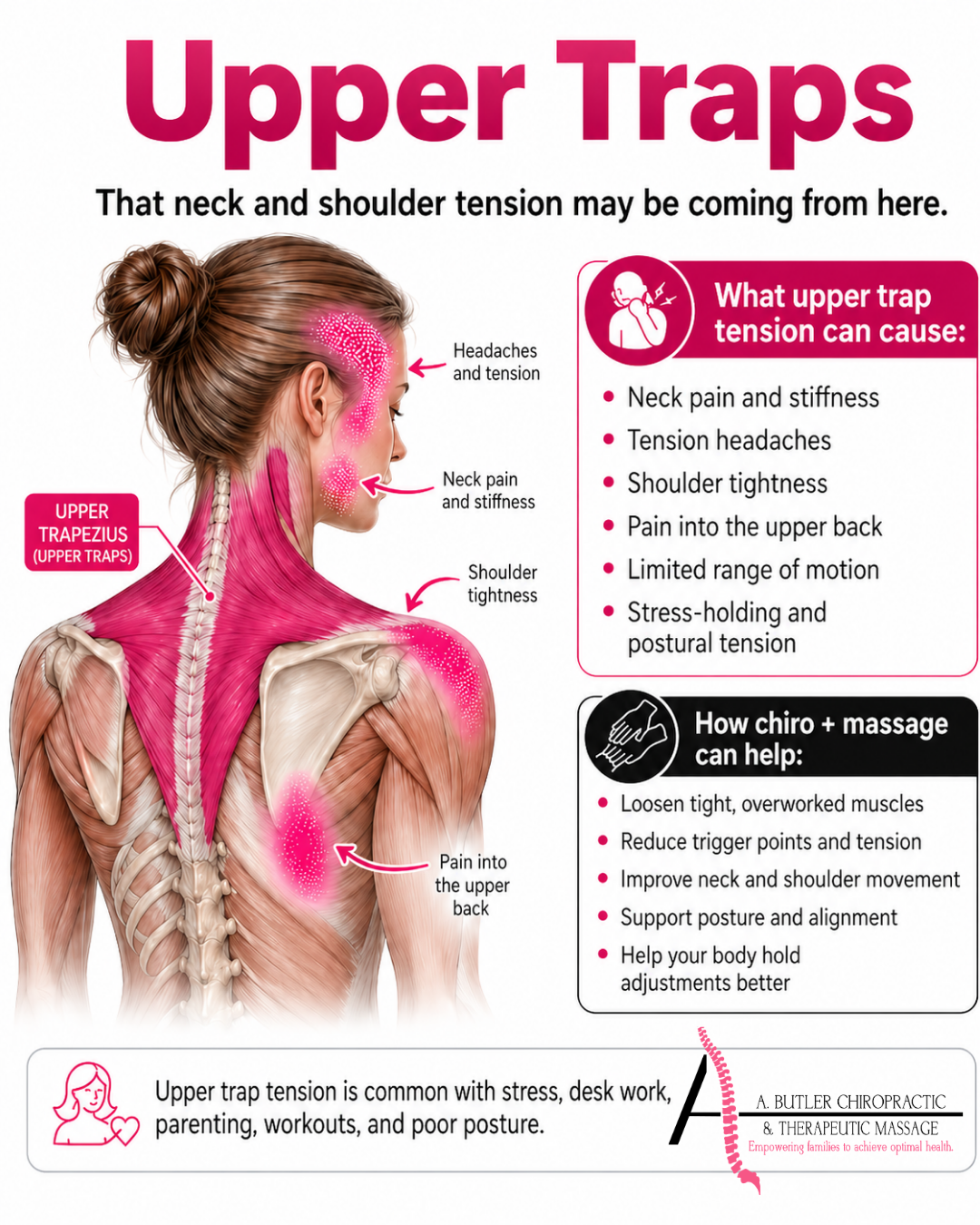
And sometimes it shows up as headaches that keep coming back, especially when the tension is pulling through the neck and up toward the base of the skull. Your graphic highlights how upper trap tension can contribute to neck stiffness, tension headaches, shoulder tightness, upper back pain, limited motion, and postural stress.
Why Do the Upper Traps Get So Tight?
Most of the time, upper trap tension is not random. It usually builds from everyday life. Think about how much your neck and shoulders do in a day:
Looking down at your phone.
Working at a desk.
Driving.
Carrying kids.
Carrying bags.
Working out.
Sleeping in odd positions.
Holding stress in your body.
Trying to get through the day without fully relaxing.
And let’s be real… stress loves to live in the shoulders.
When life feels full, busy, overwhelming, or nonstop, your body often responds by bracing. Your shoulders come up. Your jaw tightens. Your breathing gets a little more shallow. Your nervous system stays a little more “on.”
Your upper traps were not meant to carry that all day. But they try. And eventually, they start talking back.
Why This Is So Common During Pregnancy
For our pregnant mamas, upper trap tension can be even more common. As your body changes, everything has to adapt.
Your posture shifts.
Your ribcage moves differently.
Your breathing patterns can change.
Your sleep positions may not feel as comfortable.
Your center of gravity changes.
Your body is doing a lot more work behind the scenes.
Then add in stress, less sleep, caring for other kids, working at a desk, or trying to keep up with normal life while growing a human… and those upper traps can start doing way too much.
Sometimes it is not just “bad posture.” Sometimes it is your body trying to stabilize and protect you while everything is changing. That does not mean you are broken. It means your body needs support.
Why Stretching Alone Does Not Always Fix It
A lot of people try to stretch their upper traps over and over. And stretching can feel good. But if the tension keeps coming back, there is probably more going on than just a tight muscle.
Upper trap tension can be connected to:
• Joint restriction in the neck or upper back
• Poor shoulder mechanics
• Rib tension
• Stress and nervous system overload
• Forward head posture
• Weakness or imbalance in surrounding muscles
• Trigger points in the neck and shoulders
That is why you can stretch, massage, roll, or heat the area and still feel tight again by the end of the day. The muscle may be tight because it is compensating.
So instead of just asking, “How do we loosen this muscle?” We also ask, “Why does this muscle keep feeling like it has to work so hard?” That is where care becomes more effective.
How Chiropractic Care Can Help Upper Trap Tension
Chiropractic care helps by improving how the joints in your spine, neck, and upper back are moving. When those areas are restricted, your muscles often have to work harder to protect and stabilize. That can keep your upper traps stuck in a tight, guarded pattern.
Gentle chiropractic adjustments may help:
• Improve neck and upper back mobility
• Reduce stress on surrounding muscles
• Support posture and alignment
• Improve nervous system communication
• Help your body move with less tension
The goal is not just to “crack your neck.” The goal is to help your body function better so those muscles do not have to keep carrying the load all by themselves.
How Massage Helps Release Tight Upper Traps
Massage can be incredibly helpful for upper trap tension because it works directly with the soft tissue. When muscles are tight, overworked, or full of trigger points, massage can help calm that area down.
Massage may help:
• Loosen tight, overworked muscles
• Reduce trigger points
• Improve circulation
• Decrease that heavy, guarded feeling
• Improve neck and shoulder movement
• Help your body relax out of stress mode
This is why chiropractic and massage work so well together. Chiropractic helps improve the motion and function of the joints.
Massage helps calm and release the muscles around them. Together, they help your body hold the changes better.
A Few Simple Things You Can Start Today
You do not need to overhaul your whole life to start helping your neck and shoulders. Start small. Bring your phone up closer to eye level instead of dropping your head down. Take a few shoulder rolls during the day, especially if you work at a desk. Unclench your jaw when you notice it. Take slow breaths into your ribs instead of shallow breaths into your chest. Support your arms when feeding baby, holding a child, or working at a computer.
Pay attention to when your shoulders creep up toward your ears, and gently let them drop. Nothing has to be perfect. Awareness is a really good first step.
You Do Not Have to Just Live With It
Neck and shoulder tension may be common, but that does not mean it has to be your normal.
If your shoulders always feel tight…
If your neck feels stiff…
If headaches keep showing up…
If you feel like you are carrying stress in your upper body all the time…
Your body is probably asking for support. Sometimes your body does not need you to push through harder.Sometimes it needs movement, care, and a good reset.
At A. Butler Chiropractic & Therapeutic Massage, we can help you figure out what is actually contributing to your neck and shoulder tension and create a plan that makes sense for your body.
Book your chiropractic or massage appointment online HERE, or call 724-822-1828 and we will help you find the time that is right for you.