
Is Your Psoas Muscle Causing Your Low Back and Hip Tightness?
Ever feel like your low back and hips are just… mad at you? Like you stretch, shift around, sit differently, maybe blame your mattress, maybe try to “walk it off,” and somehow it still feels tight?
Your psoas muscle could be part of the reason.
The psoas is one of those muscles most people have never heard of until it starts causing problems. But once you understand where it is and what it does, a lot of that low back, hip, pelvic, and groin discomfort can start to make more sense.
What Is the Psoas Muscle?
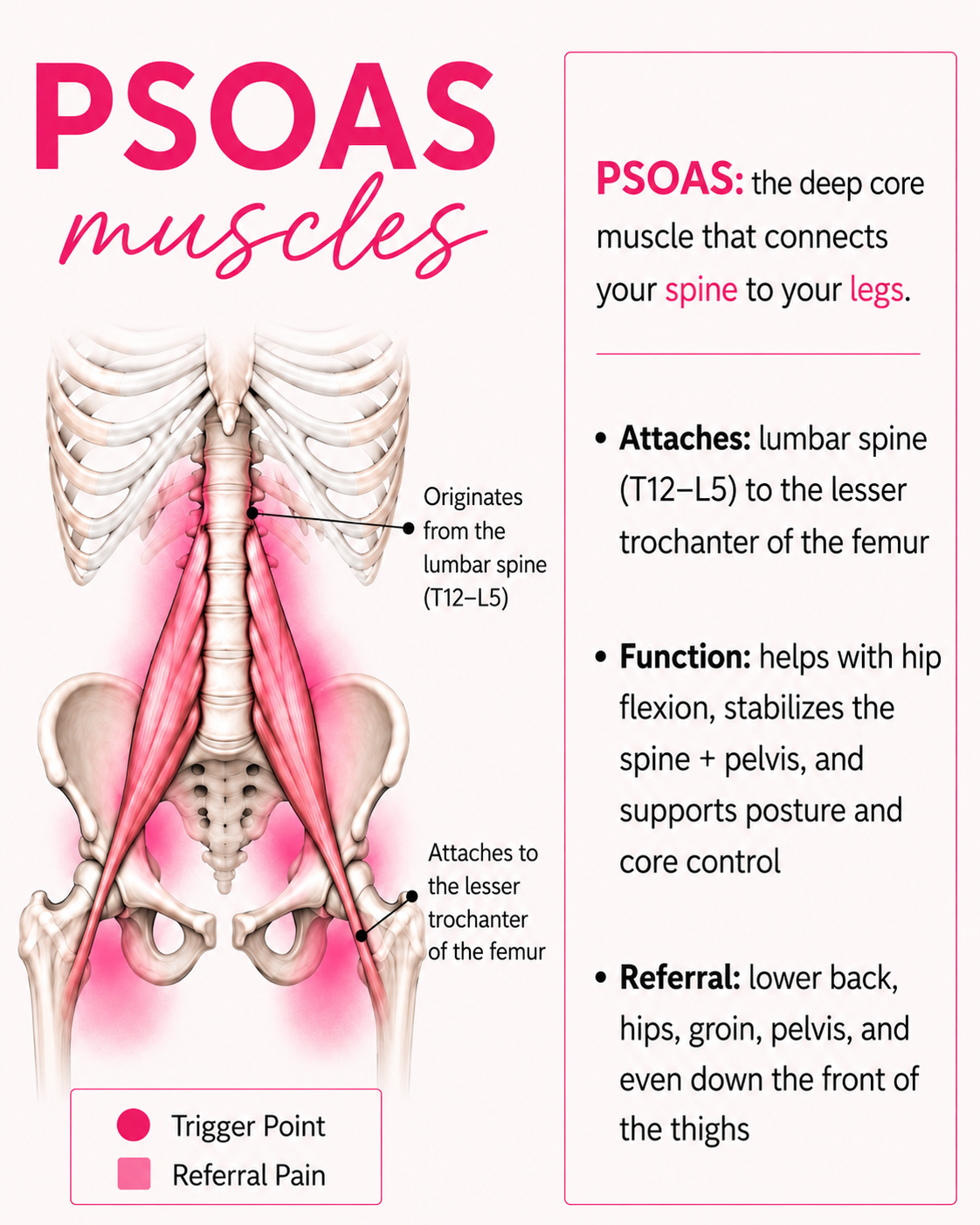
The psoas is a deep muscle that connects your low back to your hips and legs. More specifically, the psoas major starts along the lumbar spine and travels through the pelvis to attach near the top of the thigh bone, called the femur.
That means it plays a role in a lot of things your body does every day, including:
• lifting your leg
• walking
• sitting
• standing
• stabilizing your low back
• supporting your pelvis
• helping with posture and core control
So when your psoas gets tight, overworked, irritated, or guarded, it does not always feel like one simple “muscle ache.” Because of where it attaches, it can create symptoms in several areas at once.
What Does Psoas Tightness Feel Like?
When the psoas is irritated, people may feel discomfort through the low back, hips, groin, pelvis, buttock area, or even the front of the thigh. Cleveland Clinic notes that psoas-related irritation can show up as lower back pain, stiffness, hip pain, groin pain, pelvic pain, or buttock pain.
You might notice:
• low back pain that feels deep or hard to stretch
• hip tightness that keeps coming back
• pelvic discomfort
• groin pain
• a pulling feeling in the front of the hips
• stiffness after sitting too long
• discomfort when standing up after driving or working
• feeling like one hip just does not move as well as the other
And here’s the frustrating part: sometimes stretching gives temporary relief, but the tightness comes right back. That does not mean you are doing something wrong. It may mean your body is compensating.
Why Does the Psoas Get So Tight?
Honestly? Life.
A lot of us are giving our psoas plenty of reasons to be annoyed.
Sitting at work.
Driving.
Holding babies.
Pregnancy posture.
Postpartum recovery.
Stress.
Running around all day.
Sleeping in whatever position your kid, dog, or partner allows.
It adds up.
The psoas is involved in hip flexion and lumbar spine stability, especially during sitting and movement. So if you spend a lot of time seated, bent forward, bracing through stress, or moving with poor hip and core support, that area can start working overtime.
Over time, your body may start protecting itself by tightening. And while that tightness may be your body’s way of trying to help, it can also leave you feeling stiff, achy, and stuck.
Why Sitting Can Make It Worse
When you sit, your hips are flexed. Your psoas is in a shortened position.
Now sitting for a little while is not the enemy. But sitting for hours at work, sitting in the car, sitting while feeding a baby, sitting at practices, sitting on the couch at night… that’s a lot of time in one position.
If your psoas is constantly shortened, your body can start to treat that as normal.
Then when you stand up, walk, bend, or try to move freely, your low back and hips may feel like they are fighting you.
This is why so many people say things like:
“I feel fine once I get moving, but getting up is rough.”
“My hips always feel tight.”
“My low back feels worse after sitting.”
“I stretch my hip flexors all the time, but it never lasts.”
Sound familiar?
Pregnancy, Postpartum, and the Psoas Muscle
For our pregnant and postpartum mamas, the psoas can be a big piece of the puzzle.
During pregnancy, your posture changes. Your pelvis adapts. Your belly grows forward. Your core has to work differently. Your breathing patterns may shift. Your sleep positions change. And your body is constantly adjusting to support you and baby.
Postpartum, your body is still recovering while also doing a lot of repetitive work: feeding, rocking, carrying, bending, lifting car seats, and getting up and down all day.
That can put extra stress through the low back, hips, pelvis, and deep core system.
So if you feel tight in the front of your hips, achy in your low back, or like your pelvis just feels “off,” it may not be random.
Your body may be asking for support.
Why Stretching Alone May Not Fix It
Stretching can feel good. And sometimes it is helpful. But if your psoas keeps tightening back up, there may be more going on than just a short muscle.
Your body may be dealing with:
• joint restriction
• poor hip mobility
• pelvic imbalance
• core weakness or poor coordination
• nervous system stress
• muscle guarding
• compensation from old injuries or pregnancy changes
That is why we do not just chase the tight spot. We want to know why it keeps getting tight in the first place.
Because if the joints are not moving well, the muscles around them often have to work harder. And if your nervous system is stuck in stress mode, your body may keep bracing even when you are trying to relax.
How Chiropractic Care Can Help Support the Psoas Area
Chiropractic care does not “release” the psoas directly in the way massage or soft tissue work might. But it can help support the joints, movement patterns, and nervous system function that affect how that area feels.
When your low back, hips, pelvis, and spine are not moving well, your body may compensate by tightening surrounding muscles.
Chiropractic care may help by:
• improving joint motion
• reducing mechanical stress through the low back and pelvis
• supporting better nervous system communication
• helping your body move with less guarding
• improving how your hips, spine, and pelvis work together
The goal is not just to make you feel better for a day.
The goal is to help your body stop living in the same compensation pattern over and over again.
How Massage Can Help With Psoas-Related Tension
Massage can be a great support when the muscles around the low back, hips, glutes, quads, and pelvis are tight or overworked.
Because the psoas is deep, the goal is not always to dig aggressively into the front of the hip. Sometimes the best approach is calming the entire system around it.
Massage may help:
• reduce muscle tension
• calm trigger points
• improve circulation
• decrease guarding
• support better hip and low back mobility
• help your nervous system settle
Sometimes your body does not need more force.
Sometimes it needs support, mobility, and a reason to feel safe enough to let go.
When Low Back and Hip Pain Are Not Just “Normal”
Low back and hip tightness may be common, but that does not mean you have to just live with it. And it also does not mean every low back issue is automatically a psoas problem.
That is why getting checked matters.
If your pain is severe, getting worse, associated with fever, numbness, weakness, unexplained weight loss, or changes in bowel or bladder control, you should seek medical care right away. For ongoing lower back, hip, groin, or pelvic pain that does not improve, Cleveland Clinic recommends checking in with a healthcare provider.
Your body gives clues. We help connect the dots.
Your psoas is not just a random hip flexor. It is a deep core muscle that connects your spine, pelvis, hips, and legs. It helps you move, stabilize, stand, walk, sit, and function throughout the day.
So when it is tight, irritated, or overworked, it can make your low back and hips feel like they are constantly “off.”
If you have been stretching, shifting, adjusting your posture, blaming your mattress, and still feeling stuck, it may be time to stop guessing.
At A. Butler Chiropractic, we look at the bigger picture: how your joints are moving, how your muscles are compensating, and how your nervous system is adapting. Our office provides chiropractic, massage, and holistic wellness care in Lyndora, serving the Butler, PA and greater Pittsburgh areas.
If your low back or hips have been talking back lately, come get checked.
Book online HERE or call 724-822-1828 to schedule your appointment.