
Why That Nagging Shoulder Blade Knot Might Be Your Rhomboids
That deep shoulder blade ache is not always random
Most people know what it feels like to have a knot in their upper back.
It is that deep, annoying spot between your spine and shoulder blade. The one you keep reaching for throughout the day. The one that feels like it should release if you could just press on it the right way. Sometimes it feels tight and achy. Sometimes it feels sharp. Sometimes it even feels uncomfortable when you take a deep breath.
That area is often connected to a group of muscles called the rhomboids.
The rhomboids are not usually the first muscles people think about when they have shoulder pain or upper back tension, but they can play a big role in that stubborn shoulder blade discomfort that does not seem to fully go away.
What are the rhomboids?
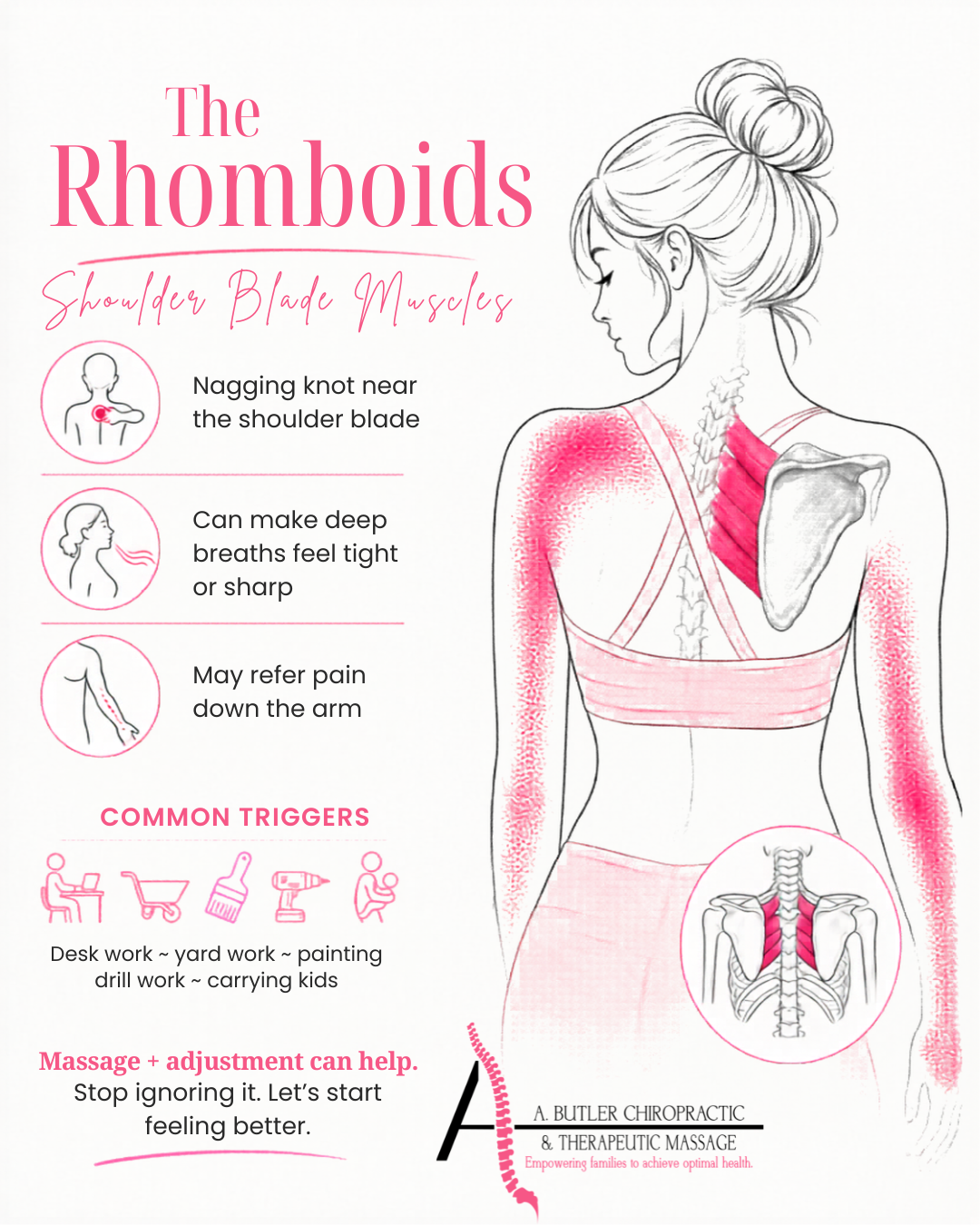
The rhomboids are muscles in your upper back that sit between your spine and your shoulder blades. Their main job is to help move and stabilize the shoulder blades.
Every time you pull your shoulders back, reach, lift, carry, or use your arms for repetitive work, your rhomboids are involved. They help your shoulder blades stay supported while your arms and upper body move.
Because they are used so often, they can become irritated or overworked when the surrounding joints and muscles are not moving well. This is especially common when your posture, work habits, or daily activities keep your shoulders rounded forward for long periods of time.
What does rhomboid pain feel like?
Rhomboid pain can feel different from person to person, but many people describe it as a deep ache, knot, or tight spot near the shoulder blade.
It may feel like:
A nagging knot between the spine and shoulder blade
A deep ache in the upper back
Sharp or stabbing pain near the shoulder blade
Tightness that gets worse with desk work or repetitive activity
Discomfort when taking a deep breath
Pain that seems to spread toward the shoulder, neck, or arm
For some people, it shows up after a long day at the computer. For others, it flares after yard work, painting, drilling, lifting, carrying kids, or using one side of the body over and over.
The frustrating part is that rubbing the spot may feel good temporarily, but the tension often comes right back.
Why do the rhomboids get irritated?
Most rhomboid pain does not come from one single dramatic injury. More often, it builds gradually.
Daily habits can place repeated stress on the upper back and shoulder blades. Sitting at a desk, using a computer mouse, driving, scrolling on a phone, carrying bags, holding children, and doing repetitive household or outdoor projects can all contribute.
Activities like weed whacking, painting, drill work, lifting, and yard work can be especially irritating because they often involve repeated arm movement while the upper back and shoulders are working hard to stabilize.
Over time, the rhomboids may begin to tighten or guard. This can happen when the muscles are doing too much work, but it can also happen when the joints of the neck, ribs, or upper back are not moving the way they should.
That is why the painful spot is not always the full problem. It may simply be the area where your body is showing stress.
Why stretching or rubbing the knot may not be enough
It makes sense to want to stretch, massage, or press on the sore spot. When something feels tight, we naturally want to loosen it.
But if the rhomboids are tightening because your upper back is restricted, your shoulders are rounded forward, or your body is compensating somewhere else, the muscle may continue to tighten again and again.
This is why so many people say, “It feels better for a little while, but then it comes right back.”
The muscle is responding to a pattern.
To create lasting relief, it is important to look beyond the knot itself and evaluate how the neck, upper back, ribs, shoulders, and shoulder blades are all working together.
How chiropractic care and massage therapy can help
At A. Butler Chiropractic & Therapeutic Massage, we look at both the joint and muscle side of shoulder blade pain.
Massage therapy can help address muscle tension, trigger points, tight fascia, and soft tissue irritation around the rhomboids and surrounding upper back muscles.
Chiropractic care helps improve movement through the spine, ribs, neck, and shoulders. When those areas move better, the muscles often do not have to guard or compensate as much.
That combination matters because your muscles and joints work together. If the muscles are tight but the joints underneath are not moving well, the tension may return. If the joints are adjusted but the soft tissue is still irritated and guarded, your body may have a harder time holding that change.
Supporting both can help your body move more comfortably and recover more completely.
What can you do at home?
If you deal with recurring shoulder blade pain, small changes throughout the day can help reduce stress on the rhomboids.
Try taking short movement breaks during desk work. Bring your shoulders gently back and down a few times throughout the day. Avoid staying rounded forward for long stretches. If you are doing repetitive work like painting, drilling, gardening, or weed whacking, pause occasionally to reset your upper back and shoulders.
It can also help to pay attention to how often you carry things on the same side. Bags, children, laundry baskets, and work equipment can all create one-sided strain when repeated often enough.
You do not need perfect posture all day. Your body just needs more variety, better movement, and support before the tension turns into pain.
When should shoulder blade pain be checked?
If shoulder blade pain keeps coming back, affects your breathing, refers into your arm, limits your movement, or interferes with your daily life, it is worth having it evaluated.
Most shoulder blade pain is related to muscles, joints, posture, or repetitive movement patterns. However, sudden or severe pain, chest tightness, shortness of breath, dizziness, sweating, weakness, or symptoms that feel unusual for you should be treated as urgent and evaluated medically right away.
For ongoing, nagging, musculoskeletal pain, chiropractic care and massage therapy may help identify what is causing the pattern and how to better support your body.
The bottom line
That stubborn shoulder blade knot may be more than just a tight muscle.
Your rhomboids may be overworked, irritated, or compensating for restricted movement in your upper back, ribs, neck, or shoulders. And while rubbing the spot may bring temporary relief, it may not address why the tension keeps coming back.
At A. Butler Chiropractic & Therapeutic Massage in Butler, PA, we take a whole-body approach to shoulder blade pain, upper back tension, and rhomboid discomfort. By supporting both the muscles and the joints, we help your body move better, feel better, and stop relying on the same compensation patterns.
If you are tired of dealing with that deep knot by your shoulder blade, we would love to help.
Book online HERE or call 724-822-1828 to schedule an appointment.