
Adductor Magnus Pain: Could This Inner Thigh Muscle Be Causing Hip, Groin, or Knee Pain?
The Muscle No One Talks About… Until It Starts Talking Back
Adductor magnus.
Not exactly the muscle everyone is casually talking about… until it starts causing problems.
That nagging groin pain?
That pinch in your hip when you walk?
That awkward inner thigh discomfort when you get out of the car?
That random pain that seems to show up near the inside of your knee?
Your adductor magnus might be part of the conversation.
And honestly, this is one of those muscles that reminds us why we cannot always assume pain is coming from the exact place we feel it.
Sometimes hip pain is not just a hip issue.
Sometimes groin pain is not just a groin issue.
Sometimes knee pain is not just a knee issue.
The body is connected, and the adductor magnus is a great example of how one overworked muscle can create discomfort in a few different places.
What Is the Adductor Magnus?
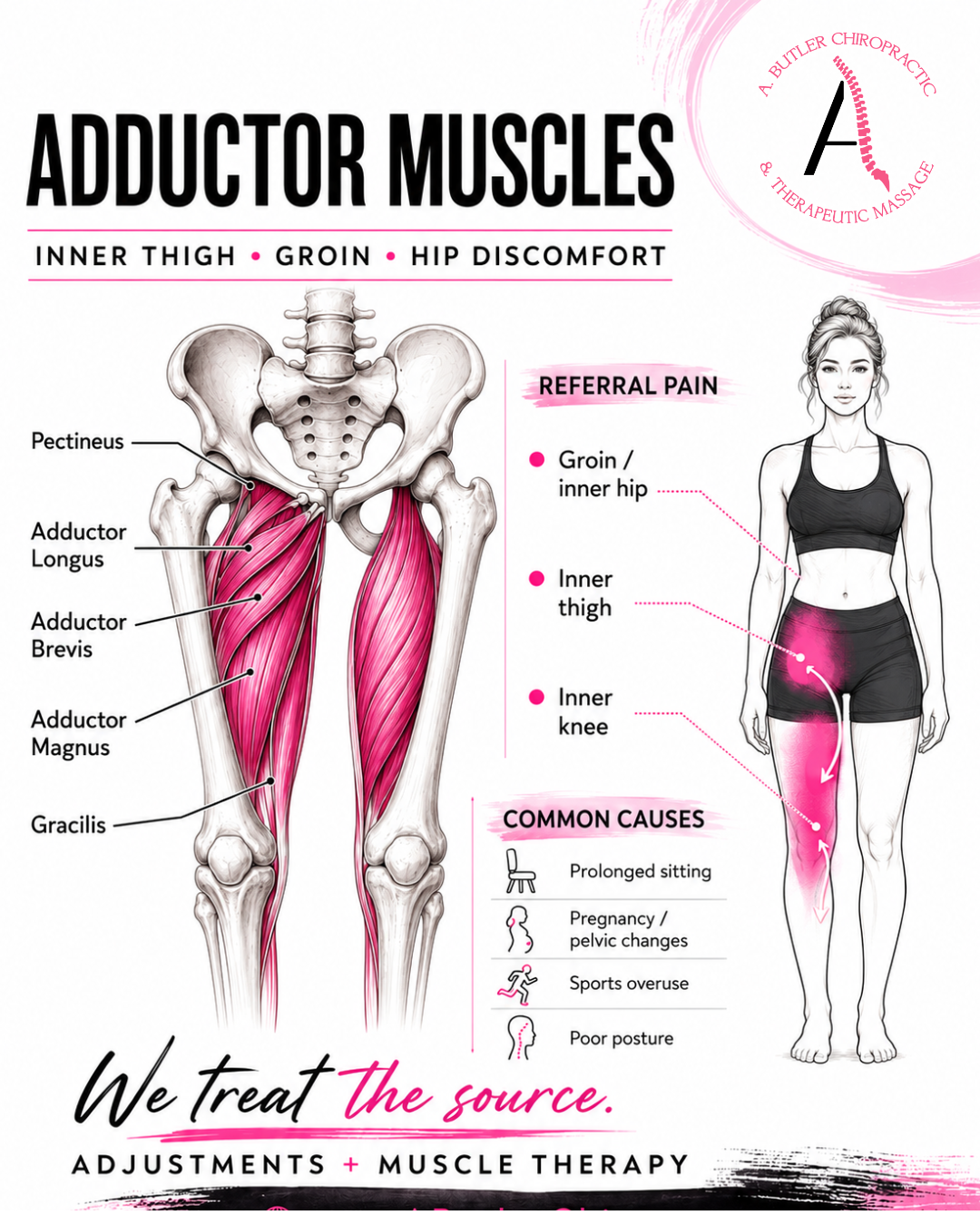
The adductor magnus is a large muscle that runs along the inside of your thigh. It is part of your adductor muscle group, which helps bring your leg inward toward the center of your body.
But that is only part of its job.
This muscle also plays a big role in stabilizing your hip, pelvis, and leg during everyday movement. Walking, climbing stairs, squatting, working out, getting in and out of the car, carrying kids, chasing kids, and simply moving through the day all involve this area more than most people realize.
The adductor magnus helps your body stay balanced and supported, especially when your weight shifts from one side to the other.
So when this muscle gets tight, irritated, overworked, or guarded, it can affect more than just the inner thigh.
It can influence how your hips move.
It can affect how your pelvis feels.
It can contribute to groin discomfort.
And it may even be part of the reason you feel pain near the inside of your knee.
What Does Adductor Magnus Pain Feel Like?
Adductor magnus pain does not always show up in one obvious spot.
That is what makes it tricky.
When this muscle is irritated or overworked, you may notice:
• Groin pain
• Inner thigh pain or tightness
• Hip pinching or pulling
• Pelvic discomfort
• Pain with walking
• Pain with stairs
• Discomfort getting in or out of the car
• Tightness after workouts
• A pulling sensation through the inside of the leg
• Pain near the inside of the knee
And because those symptoms can overlap with other hip, pelvic, low back, or knee issues, the adductor magnus can be easy to miss.
A lot of people come in saying, “I do not even know how to explain it. It just feels weird.”
And that makes sense.
Pain patterns are not always simple. Muscles, joints, nerves, fascia, posture, movement habits, stress, pregnancy, workouts, and daily life all layer together.
Your body usually has a reason for what it is doing.
We just have to figure out the pattern.
Why the Adductor Magnus Gets Overworked
The adductor magnus can start working overtime for a lot of reasons.
Sometimes it is exercise-related. Squats, lunges, running, lateral movements, sports, skating, soccer, and quick changes in direction can all place extra demand on the inner thigh muscles.
Sometimes it is daily life. Sitting for long periods, driving, crossing your legs, standing unevenly, carrying a child on one hip, or always moving in the same patterns can create tension through the hips and pelvis.
Sometimes it is compensation.
If your glutes, deep core, pelvic floor, low back, or hip stabilizers are not coordinating well, the adductor muscles may step in and try to help.
Helpful? Yes.
Sustainable forever? Not usually.
Your body is smart. It will compensate to keep you moving. But eventually, those compensation patterns can start showing up as tightness, pinching, pulling, or pain.
That is when the adductor magnus may go from quietly doing its job to loudly asking for support.
Why It Can Feel Like Hip, Groin, or Knee Pain
The adductor magnus attaches through the pelvis and thigh, so it has a lot of influence on how the hip and leg move.
When it is irritated, it may not feel like one clean, obvious “muscle pain.”
Instead, it can feel like:
“My hip keeps pinching when I walk.”
“My groin feels tight.”
“My inner thigh feels pulled.”
“My knee hurts on the inside.”
“I feel it most when I get out of the car.”
“It is worse after sitting.”
“It feels like something is stuck.”
This is why we do not just chase the painful spot.
If the inside of your knee hurts, we still want to know what your hip is doing.
If your groin hurts, we still want to know how your pelvis is moving.
If your hip is pinching, we still want to know whether your inner thigh muscles are guarding.
Because the place you feel the pain is not always the full story.
And for Pregnant Moms… This Area Can Get Extra Sensitive
Pregnancy adds a whole new layer to the hips and pelvis.
Your posture changes.
Your center of gravity shifts.
Your pelvis is adapting.
Your ligaments are becoming more relaxed.
Your muscles are working differently.
And your body is trying to create space while still helping you move through everyday life.
So if you are pregnant and noticing more groin pain, pelvic discomfort, inner thigh tightness, or pubic-area pain, you are not imagining it.
Sometimes that sharp, sudden “lightning crotch” feeling is related to pressure around the cervix or pelvic nerves. Sometimes pelvic discomfort is connected to how the hips, pelvis, and surrounding muscles are adapting. And sometimes muscles like the adductor magnus are part of the tension pattern making the whole area feel more sensitive.
Because pregnancy really does like to keep things interesting.
But you do not have to just push through every ache and weird sensation like it is “just part of it.”
Support matters.
At A. Butler Chiropractic, we often look at how the pelvis, low back, hips, inner thighs, and nervous system are working together, especially during pregnancy. The goal is not to force anything. The goal is to help your body feel more supported as it adapts.
Why We Don’t Only Focus on Adjustments
This is exactly why we look at more than just the joint.
Joints and muscles work together.
If a hip, pelvis, or low back joint is not moving well, the muscles around it may tighten to protect the area.
If a muscle is tight, guarded, or overworked, it can pull on the joints and change how you move.
If your nervous system is stressed or stuck in a protective pattern, the whole area may stay more sensitive than it needs to be.
So if we only adjust the joint but ignore the muscle tension, the body may keep pulling itself right back into the same pattern.
And if we only work on the muscle but ignore how the joint is moving, the tension may keep returning.
That is why chiropractic care and therapeutic massage can work so well together.
One supports how the joints and nervous system are functioning.
The other helps address muscle tension, soft tissue restriction, and compensation patterns.
When we address both, the body often has a much better chance of responding.
How Chiropractic Care and Therapeutic Massage Can Help
When someone comes into A. Butler Chiropractic with hip, groin, inner thigh, pelvic, or inside-of-the-knee discomfort, we are not just asking, “Where does it hurt?”
We are asking:
Why is that area being overloaded?
Is the pelvis moving well?
Are the hips stabilizing properly?
Is the low back contributing?
Is the adductor magnus guarding?
Are other muscles compensating?
Is the nervous system stuck in protection mode?
Care may include gentle chiropractic adjustments, therapeutic massage, soft tissue work, mobility support, movement recommendations, and helping the body calm down enough to stop bracing.
Because the goal is not just temporary relief.
The goal is helping your body move with more ease.
At A. Butler Chiropractic in Lyndora, PA, we help patients from Butler and the surrounding areas get to the root of hip pain, groin pain, inner thigh pain, pelvic discomfort, and knee discomfort by looking at how the body is functioning as a whole.
A Simple Place to Start
If you are dealing with inner thigh or groin tightness, start gently.
Nothing aggressive.
Try paying attention to how you move through the things that trigger it most:
Getting out of the car
Going up and down stairs
Standing from a chair
Rolling in bed
Squatting or lunging
Walking after sitting for a long time
Move a little slower. Keep your knees and hips moving together instead of twisting through one side. If you are pregnant, try keeping your knees closer together when getting out of the car or rolling in bed, and use support when needed.
You can also try gentle breathing with your feet supported and your knees bent. Let your inner thighs soften instead of forcing a deep stretch.
Because sometimes the body does not need more intensity.
Sometimes it needs safety, support, and better coordination.
When to Get It Checked
If your hip, groin, inner thigh, pelvic, or knee discomfort keeps coming back, it is worth taking a closer look.
Especially if you notice pain with walking, stairs, workouts, pregnancy movement, getting in and out of the car, or if one side just feels like it is always tighter than the other.
And of course, if pain is severe, sudden, associated with swelling or bruising, you cannot bear weight, or you are pregnant and experiencing constant pain, bleeding, leaking fluid, contractions, fever, or anything that feels concerning, please contact your medical provider right away.
Your body deserves support, not guessing.
The Bottom Line
The adductor magnus may not be the most famous muscle, but it can play a big role in how your hips, pelvis, groin, inner thigh, and knees feel.
If you have been dealing with stubborn discomfort that has not fully made sense, this muscle could be one of the missing pieces.
And that is why we do what we do.
We do not just chase symptoms.
We look at the pattern.
Because when we address the joints, muscles, movement, and nervous system together, the body usually has a much better chance of responding.
If you have been dealing with hip pain, groin pain, inner thigh pain, pelvic discomfort, or inside-of-the-knee pain, we would love to help you figure out what is actually going on.
Book online HERE or call 724-822-1828 to schedule with A. Butler Chiropractic.
Quick Answers
What does the adductor magnus do?
The adductor magnus helps bring your leg inward toward the center of your body, but it also helps stabilize your hip, pelvis, and leg during walking, stairs, exercise, and daily movement.
Can the adductor magnus cause groin pain?
Yes, irritation or overuse of the adductor muscles can contribute to groin pain and inner thigh discomfort. Because the hip, pelvis, and inner thigh work together, the pain may not always feel like it is coming from one obvious spot.
Can the adductor magnus cause knee pain?
It can sometimes contribute to discomfort near the inside of the knee because of how the inner thigh muscles connect and influence movement through the leg. That does not mean every inside-knee pain is from the adductor magnus, but it can be part of the pattern.
Can chiropractic care help with adductor magnus pain?
Chiropractic care may help by improving how the hips, pelvis, low back, and surrounding muscles are moving together. When chiropractic care and therapeutic massage are combined, the body often has an easier time releasing compensation patterns.
Is adductor magnus pain common during pregnancy?
Pregnancy can increase stress through the pelvis, hips, groin, and inner thighs. The adductor magnus may be one piece of the tension pattern, especially when movements like stairs, rolling in bed, or getting out of the car feel uncomfortable.
Can therapeutic massage help inner thigh and groin tightness?
Therapeutic massage may help reduce muscle tension, improve soft tissue mobility, and support better movement through the hips and pelvis. When paired with chiropractic care, it can be helpful for addressing both the joint and muscle pieces of the pattern.