
Why Your Baby Prefers Turning Their Head to One Side: Let’s Talk About Torticollis
When Baby Always Looks One Way
Have you ever noticed your baby always seems to look the same direction?
Maybe every picture has their little head turned to the right. Maybe they feed beautifully on one side but get frustrated on the other. Maybe tummy time feels like a full-body protest. Or maybe you’ve noticed a flat spot starting to develop on one side of their head and thought, “Is this something I should be worried about?”
First, take a breath.
You are not a bad parent. You did not “miss something.” And you are definitely not alone.
One-sided head preference is something we see often with babies, and one possible reason is a condition called infant torticollis. Torticollis happens when the neck muscles are tight, imbalanced, or restricted in a way that causes baby’s head to tilt or turn more easily to one side. It can be present from birth or develop as baby grows and spends more time in certain positions.
What Is Infant Torticollis?
Torticollis is sometimes called “wryneck,” but most parents know it more as, “My baby will not turn their head both ways.”
In babies, it often involves the sternocleidomastoid muscle, also called the SCM. That is the muscle that runs from behind the ear down toward the collarbone. When one side is tighter or not moving as well, baby may naturally tilt or rotate their head in one direction more than the other.
And because babies are still learning how to move, feed, sleep, and regulate their bodies, that one-sided preference can start showing up in a lot of everyday moments.
Not always dramatically.
Sometimes it is subtle.
Sometimes it is the kind of thing you only notice after the fifth time you say, “Why do they always look that way?”
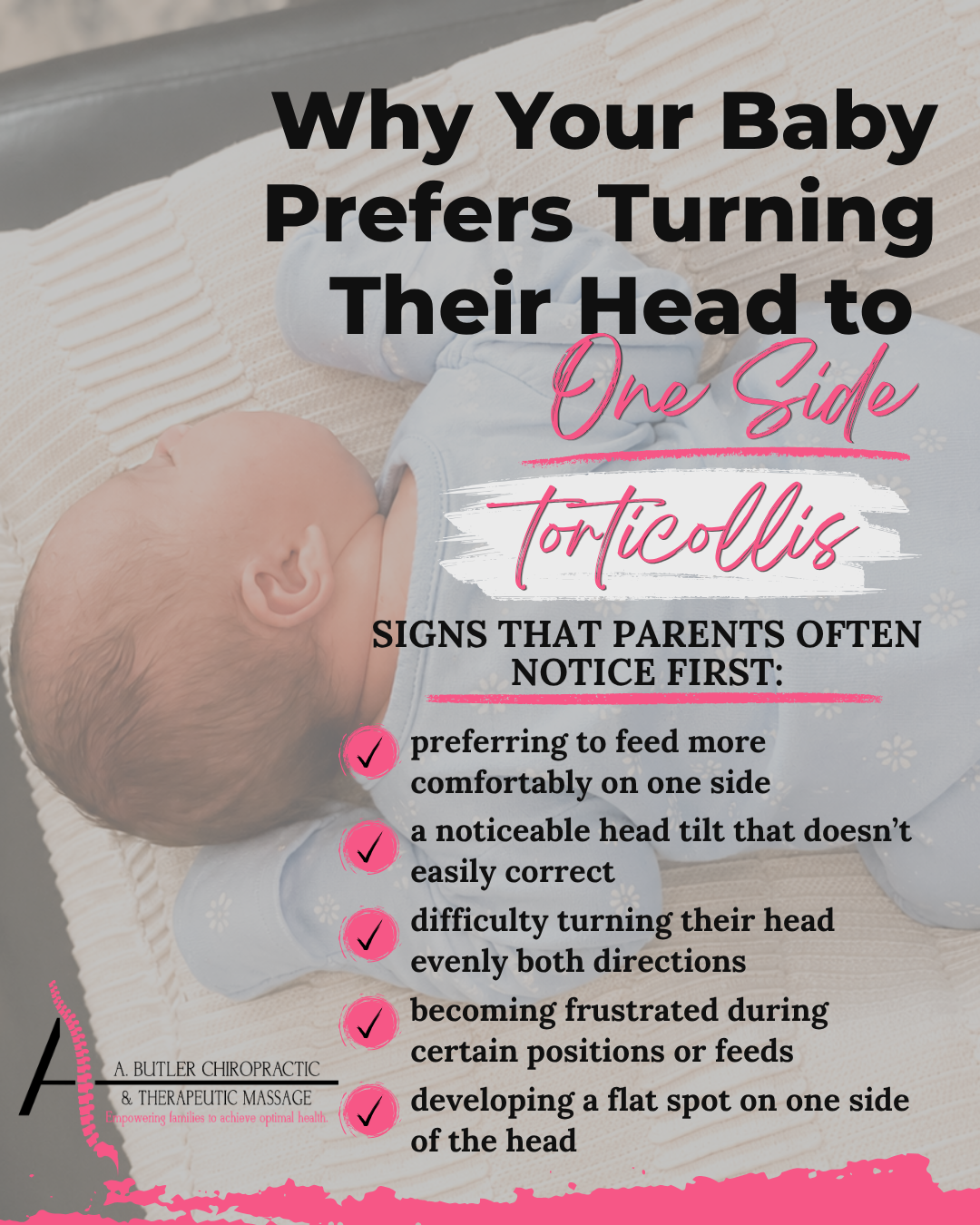
Signs Parents Often Notice First
Parents are usually the first ones to notice the little patterns because you are the one holding, feeding, changing, and staring at that sweet baby all day long.
Common signs of torticollis or one-sided head preference can include:
Your baby prefers turning their head to one side.
They feed more comfortably on one breast or bottle position.
They seem frustrated when positioned a certain way.
They have trouble turning their head evenly in both directions.
Their head tilts to one side and does not easily correct.
They develop a flat spot on one side or the back of the head.
They seem uncomfortable during tummy time or when lying in certain positions.
They struggle to follow you or a toy equally both directions.
These signs are commonly described in pediatric torticollis resources, including trouble turning the head, breastfeeding preference on one side, head tilt, and flat spots related to repeated positioning.
Why Feeding Can Feel Harder on One Side
This is one of the biggest things parents bring up.
“Baby latches great on one side, but the other side is a fight.”
And honestly, that can feel so confusing. Because if baby can latch, why can’t they latch on both sides?
Feeding takes more coordination than most people realize. Baby has to turn their head, open their jaw, coordinate their tongue, breathe, swallow, and stay calm enough to keep going. That is a lot for a tiny nervous system.
So if baby’s neck, jaw, shoulders, or upper body feel tight, feeding may feel easier when their body is turned one way and harder when they have to rotate the opposite direction.
This does not mean you are doing anything wrong.
It may simply mean baby’s body is telling us, “This side feels harder.”
The Flat Spot Connection
When a baby prefers one side, they naturally spend more time resting on that side of their head. Over time, that repeated pressure can contribute to a flat spot, also called positional plagiocephaly.
This is why early awareness matters. Not because we want parents panicking over every little head turn, but because the earlier we notice the pattern, the easier it usually is to support better movement and positioning.
The American Academy of Pediatrics notes that torticollis and positional skull changes can be connected, and babies with torticollis may need physical therapy support. Babies should still always be placed on their backs for sleep, with supervised tummy time and varied positioning used while awake.
So yes, we want to protect baby’s head shape.
But no, that does not mean putting baby to sleep on their belly or side. Back sleeping is still the safe sleep recommendation.
Think of it this way:
Back to sleep.
Tummy to play.
Variety when awake.
Why Does Torticollis Happen?
Sometimes it starts before birth because of baby’s position in the womb.
Sometimes it is related to a long labor, fast labor, C-section, assisted delivery, or just the normal physical work of being born.
Sometimes it develops from positioning after birth, especially if baby strongly prefers looking one direction during sleep, feeding, car seat time, or play.
And sometimes there is no big dramatic reason. Baby just has a tension pattern that their body keeps repeating.
That is why we try not to frame this as something parents caused. Most of the time, it is not one thing. It is a pattern.
And once we see the pattern, we can support it.
What You Can Start Noticing at Home
Before you start Googling stretches at midnight and overwhelming yourself, start with observation.
Watch how your baby naturally rests.
Do they always turn toward the same window, light, or sound?
Do they turn toward you easily on one side but struggle on the other?
Do they feed better when held a certain way?
Do they get upset when you try to reposition them?
Do they flatten more on one side of the head?
Do they resist tummy time because turning or lifting their head feels hard?
These little clues can be really helpful when you talk with your pediatrician, pediatric physical therapist, lactation consultant, or pediatric chiropractor.
You do not need to diagnose your baby at home. You just need to notice the pattern.
Simple Ways to Support Baby’s Movement
There are gentle things many parents can do during normal daily routines to encourage more balanced movement.
You can switch which side you hold baby on.
You can alternate feeding positions when possible.
You can place toys, faces, or interesting sounds on the side baby does not prefer.
You can do short, supervised tummy time sessions throughout the day.
You can reduce long stretches in containers like swings, bouncers, and car seats when baby is not traveling.
You can change which direction baby lies in the crib while still placing them on their back to sleep.
Pediatric sources often recommend encouraging baby to turn both directions, using supervised tummy time, changing positions, and involving physical therapy when needed.
The goal is not to force baby’s head.
The goal is to invite movement in a way their body can tolerate.
Gentle matters.
Consistency matters.
And when something feels stuck, uncomfortable, or like it is not improving, that is when it is time to get support.
Where Chiropractic Care Fits In
At A. Butler Chiropractic & Therapeutic Massage, we look at babies through a very gentle, whole-body lens.
With infants, care is not about twisting, cracking, or forcing anything. Pediatric chiropractic care is very light, specific, and focused on helping baby’s body move and regulate with more ease. Reviews discussing pediatric chiropractic note that techniques used with children are typically gentle and low-force, while also emphasizing that pediatric care should be thoughtful and not replace appropriate medical evaluation.
For a baby with a strong head preference, we are looking at things like:
How baby turns their head.
How their neck and upper back are moving.
How much tension they are holding through the jaw, shoulders, ribs, and spine.
How they tolerate different positions.
How their nervous system responds to touch and movement.
How feeding, sleep, tummy time, and comfort are being affected.
We are not here to replace your pediatrician, lactation consultant, or pediatric physical therapist. We love when babies have a supportive team. Our role is to gently assess how baby’s body is functioning and help support the movement and tension patterns that may be making everyday things feel harder.
Because sometimes baby is not being “difficult.”
Sometimes their body is uncomfortable.
When to Talk to Your Pediatrician
It is always a good idea to bring up one-sided head preference, feeding difficulty, head tilt, or flat spots with your pediatrician.
You should reach out promptly if your baby has a sudden head tilt, seems in pain, has a fever, is unusually sleepy, is vomiting, is not feeding well, is not gaining weight, has a firm lump in the neck, or if the head shape is changing quickly.
Most infant torticollis cases improve with early support, positioning, stretches or exercises guided by a professional, and physical therapy when needed. But getting the right eyes on it early can make a big difference.
The Earlier We Support It, the Better
One of the most reassuring things about torticollis is that early support can help.
That does not mean everything changes overnight. Babies are growing fast, and their bodies need repetition, comfort, and time. But when we catch these patterns early, we can usually help baby build better movement before the preference becomes more deeply ingrained.
And for parents, that support can feel like a huge relief.
Because it is exhausting when every feed feels like a puzzle.
It is stressful when tummy time always ends in tears.
It is overwhelming when you keep noticing the same flat spot and wondering if it is getting worse.
You do not have to sit in that worry and try to figure it out alone.
A Gentle Reminder for Parents
If your baby prefers one side, it does not mean you failed.
It does not mean you held them wrong.
It does not mean you should have noticed sooner.
It means your baby’s body is showing you a pattern, and now you get to support it.
That is it.
And honestly? That is what parenting is half the time. Noticing. Adjusting. Getting support. Trying again.
If your baby is always turning one way, feeding better on one side, struggling with tummy time, developing a flat spot, or just seems uncomfortable in certain positions, we would be happy to take a gentle look.
A. Butler Chiropractic is located in Lyndora, PA, and serves families in the Butler area. You can call 724-822-1828 or book online HERE to schedule.