
Breastfeeding Support: How Chiropractic Can Help Mom & Baby Feel More Comfortable
Breastfeeding is beautiful… and it can also be really hard. 🩷
I want to start there because so many moms feel like they’re the only ones struggling. Like everyone else figured it out and you’re the only one Googling “why does breastfeeding hurt” at 2:00 a.m. with tears in your eyes and a baby who’s still hungry.
If that’s you, you’re not failing. You’re not “doing it wrong.”
You’re doing something that takes a lot of skill, a lot of patience, and a whole lot of support.
Breastfeeding is natural, yes—but natural doesn’t automatically mean easy. It’s a learning process for both you and baby. It takes positioning, comfort, coordination, and honestly… a lot of communication between two nervous systems that are still getting to know each other.
Why Breastfeeding Can Feel Challenging (Even When Everything Seems “Normal”)
When breastfeeding is hard, most people want a single cause and a single fix.
But in real life, it’s rarely one thing.
Feeding relies on how well both mom’s and baby’s bodies can:
move
relax
coordinate
adapt
Sometimes you can have a great latch one feeding, and the next feeding feels like you’re starting over from scratch. Sometimes baby feeds well on one side but fights the other. Sometimes your supply is fine, but feeding still feels stressful and exhausting.
That’s not you being inconsistent. That’s the process being… a process.
The Missing Piece Many People Don’t Talk About: The Nervous System
Here’s something I wish every mom knew early on:
Breastfeeding isn’t just about nipples and milk transfer.
It’s also about the nervous system.
Feeding goes best when both mom and baby are in a calmer state—when the body feels safe enough to relax, coordinate, and do the job.
When either mom or baby is stuck in tension, guarding, or overwhelm, feeding can start to feel like a struggle instead of a connection.
And again: that doesn’t mean anything is “wrong” with you. It means your systems might need support.

For Baby: Why Tension Can Affect Latch & Feeding
From baby’s side, feeding takes a surprising amount of coordination.
Baby needs to move and coordinate their:
jaw
neck
tongue
shoulders
ribcage
That’s a lot for a tiny body.
If baby is holding tension (which can happen from birth, positioning in the womb, or early adaptation), that tension can show up as:
trouble latching
popping on and off
clicking sounds while feeding
difficulty staying latched
pulling away, fussing, or seeming uncomfortable
preferring one side over the other
Sometimes it’s not that baby “doesn’t know how.” Sometimes their body is tight or restricted in a way that makes feeding feel harder than it needs to.
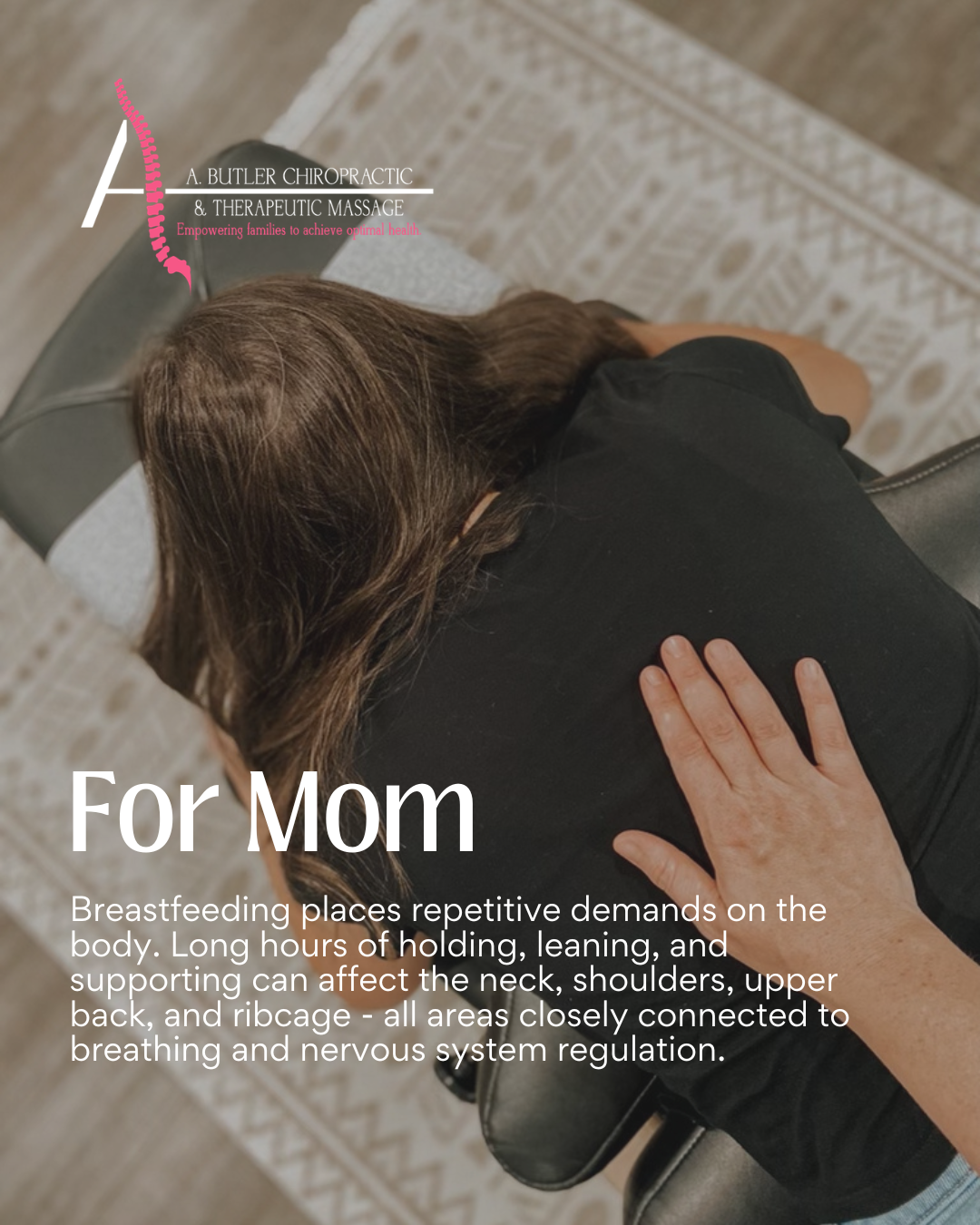
For Mom: Why Breastfeeding Can Wreck Your Neck, Shoulders, and Back
Now let’s talk about you. Because you matter too.
Breastfeeding is repetitive. Even with good posture and the best pillow setup, you’re still doing some version of:
holding
leaning
supporting
hunching
looking down
staying in one position for long stretches
Over time, that can light up the areas moms complain about the most:
neck and shoulders
upper back
ribs
mid back
wrists and hands
And those areas aren’t random. They’re connected to breathing and nervous system regulation. So when your ribs are tight and your shoulders are stuck up by your ears, your breath gets shallow. When your breath gets shallow, your nervous system stays more “on.”
That’s why you can feel exhausted but still not able to fully relax.
How Chiropractic Support Can Help
So where does chiropractic care fit into all of this?
In our office, chiropractic care is about improving how your brain and body communicate, and helping your body move with more ease. We’re not trying to “force” anything. We’re supporting the system so feeding feels less like a fight.
For baby
Gentle, specific pediatric chiropractic care can help reduce tension in the neck and spine and improve how baby’s body coordinates movement. With babies, adjustments are very light and precise—nothing aggressive, no twisting or cracking. The goal is to help baby feel more comfortable turning their head, moving their jaw, and relaxing into feeding.
For mom
Chiropractic care can help with the strain that builds up through the spine and ribs while you’re feeding and holding baby. When your body moves better and your nervous system is more regulated, many moms notice they feel less tight, breathe easier, and aren’t carrying so much tension through their shoulders and upper back.
For both nervous systems
This is the part that matters most: when your nervous system feels supported, your body can shift out of “brace and survive” mode and into “rest, digest, and connect” mode.
And breastfeeding is way easier to do when your system can actually settle.

What Families Often Notice Over Time
I’m always careful to say this: feeding may not become instantly perfect overnight. But families often notice that it becomes less challenging.
Over time, they may see things like:
baby latching more comfortably
baby staying latched more consistently
less fussing during feeds
mom feeling less tension through neck and shoulders
feeding feeling calmer, smoother, and more connected
Sometimes the change is subtle—but when you’re in the thick of postpartum, subtle changes can feel huge.
A Gentle Reminder About Feeding “The Right Way”
If you need to hear this today:
Breastfeeding doesn’t have to look a certain way to be “good.”
And your feeding journey does not define your worth as a mom.
Whether you’re exclusively breastfeeding, pumping, combo feeding, using formula, supplementing, or doing any mix of all of it—you deserve support.
Sometimes supporting the nervous system on both sides creates space for breastfeeding to unfold more gently. And sometimes it supports you in making decisions that protect your mental health and your baby’s wellbeing. Both are valid.
Want Support? We’re Here.
If breastfeeding has been challenging—pain, latch issues, tension, exhaustion, or just feeling like something is off—you don’t have to white-knuckle your way through it.
At A. Butler Chiropractic, we support moms and babies with gentle, nervous-system-focused care to help feeding feel more comfortable and sustainable.
If you have questions, we’re happy to talk through what you’re noticing and help you decide if chiropractic support might be a good next step for you and baby.
🩷 You can book online HERE or call 724-822-1828 and we’ll help you find a time that works with real life (and nap windows).