
Is Your “Low Back Pain” Actually Coming From Somewhere Else?
Most people assume that if they feel pain in their low back, hip, or groin, the problem must be coming from that exact spot.
But sometimes the real issue starts a little higher up in the spine.
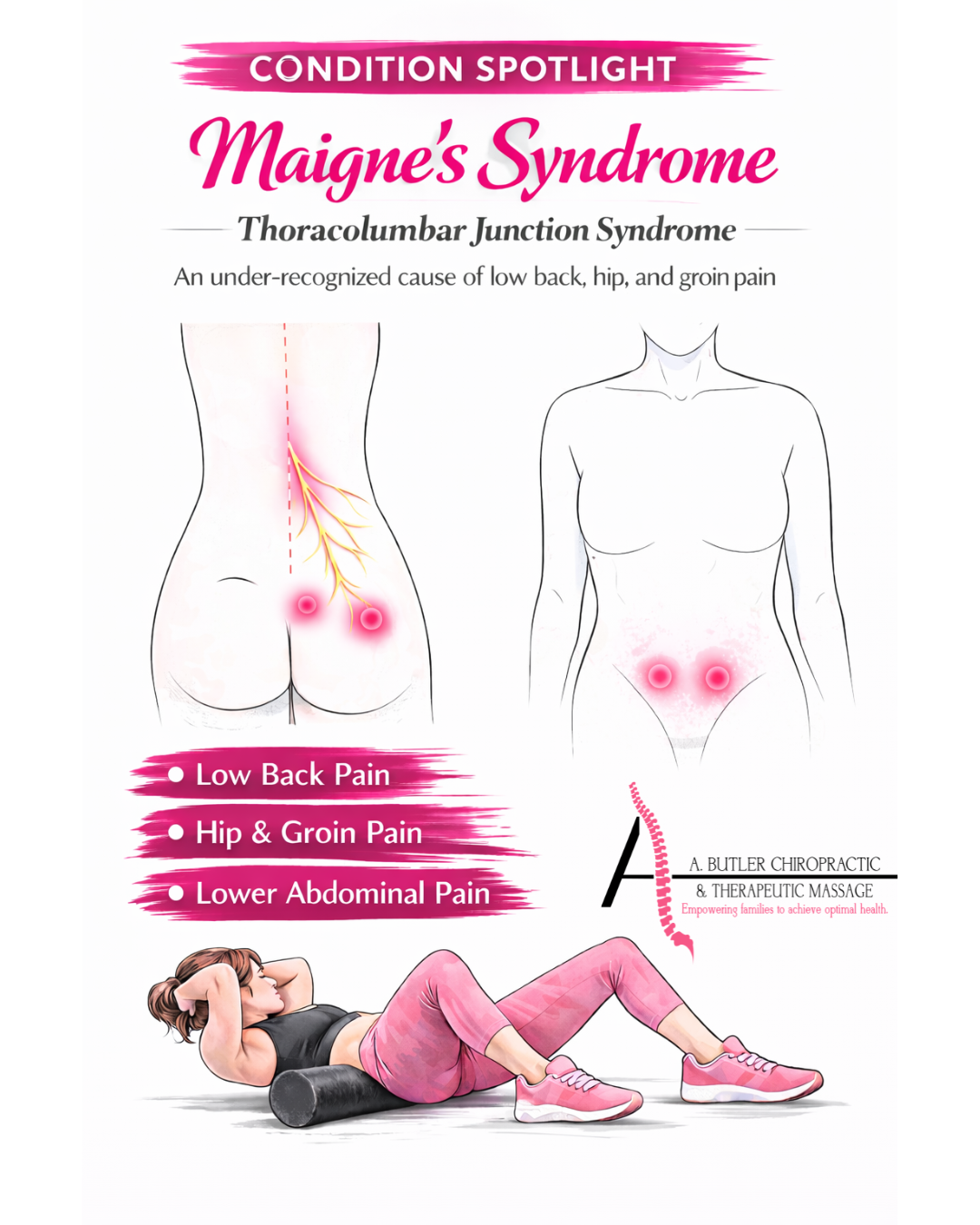
There’s a condition called Maigne’s Syndrome, also known as Thoracolumbar Junction Syndrome, that can cause pain in the low back, hip, groin, pelvis, or even the lower abdomen.
And here’s the surprising part…
Many people dealing with this type of pain have never heard of it before.
Why We Talk About Muscles AND Nerves So Much
In our office, we spend a lot of time talking about muscles and nerves.
There’s a simple reason for that.
Actually two reasons.
1. They are linked.
2. They are linked.
Nerves can become irritated by structures in the spine, including the bones, joints, and discs. When this happens, those nerves can send pain signals to other areas of the body.
Muscles can create similar patterns.
When muscles develop trigger points, they can refer pain somewhere completely different from where the muscle problem actually is.
That’s why when someone comes into our office with pain, we don’t just look at where it hurts.
We look at what could be causing the pain pattern.
What Is Maigne’s Syndrome?
Maigne’s Syndrome occurs at the thoracolumbar junction, the area where the thoracic spine meets the lumbar spine.
This transition typically occurs around the T12–L1 vertebrae.
This area is important because the thoracic spine is naturally more stable and rigid, while the lumbar spine is more mobile. That change in movement creates a point where mechanical stress often builds up.
When the joints in this area become restricted or irritated, they can affect the small nerves that travel into surrounding tissues.
The result?
Pain that shows up in places that don’t seem directly related to the spine.
Common Symptoms of Maigne’s Syndrome
People experiencing thoracolumbar junction irritation may notice pain in areas such as:
Low back
Upper buttock
Hip
Groin
Pelvic region
Lower abdomen
Because these symptoms appear outside the spine, this condition is sometimes mistaken for:
Hip problems
Sacroiliac joint dysfunction
Muscle strain
Abdominal issues
Another key feature is that Maigne’s Syndrome typically does not cause pain that travels below the knee, which can help distinguish it from other lumbar nerve conditions.
Why This Condition Is Often Missed
One reason Maigne’s Syndrome can go unnoticed is because the pain doesn’t stay in the spine.
Instead, it follows a referred pain pattern, which means the discomfort is felt in nearby regions like the hip or pelvis rather than the exact joint that is irritated.
Without evaluating the thoracolumbar junction, it’s easy to assume the problem is located somewhere else.
How Chiropractic Care Can Help
The good news is that Maigne’s Syndrome often responds well to conservative treatment.
Care typically focuses on restoring motion and reducing irritation in the thoracolumbar junction.
Treatment may include:
Chiropractic adjustments to improve spinal movement
Manual therapy to address surrounding muscle tension
Trigger point work to reduce referred muscle pain
Targeted exercises to improve stability and posture
Addressing both joint function and muscle balance can help reduce the stress placed on this important transition area of the spine.
Sometimes Pain Isn’t About Where It Hurts
One of the biggest lessons we see in practice is this:
Pain is not always coming from the place you feel it.
A hip, groin, or pelvic discomfort might actually start higher in the spine, where nerves and muscles interact.
When we identify the true source of the problem, treatment becomes much more effective.
Could This Be Causing Your Pain?
If you’ve been dealing with nagging hip, pelvic, groin, or lower back pain that hasn’t made sense, it may be worth looking a little higher up the spine.
Sometimes the body gives clues—we just need to know where to look.
If you’re ready to figure out what’s really causing your discomfort, we’d love to help.
Schedule an appointment at A. Butler Chiropractic today! Book online HERE or call 724-822-1828 to get started. 🩷🖤