
Your Feet Hurt. Your Legs Are Tight. You Keep Going.
You get through the workday, stop for groceries, stand through dinner, and finally sit down when everyone else is settled. That is when your feet start talking. Or your calves feel tight. Or your hips remind you that you have been on the move since morning.
Maybe you spent the day teaching a classroom, caring for patients, or going between a desk and the car. Maybe you stood through your kid’s practice, helped an aging parent, and still have laundry waiting. There may not be one big injury you can point to. It is just a lot of ordinary life, day after day.
For a lot of women, especially moms, the first thought is, “I’ll deal with it later.” Later has a way of turning into next week.
I want to offer you a different way to look at wellness care. You do not have to wait until pain has taken over your schedule to pay attention to your body. You can notice the small things, ask why they keep showing up, and choose care that fits your actual life.
It is about including yourself in the care you are already so good at giving everybody else.
The sore spot is not always the whole story
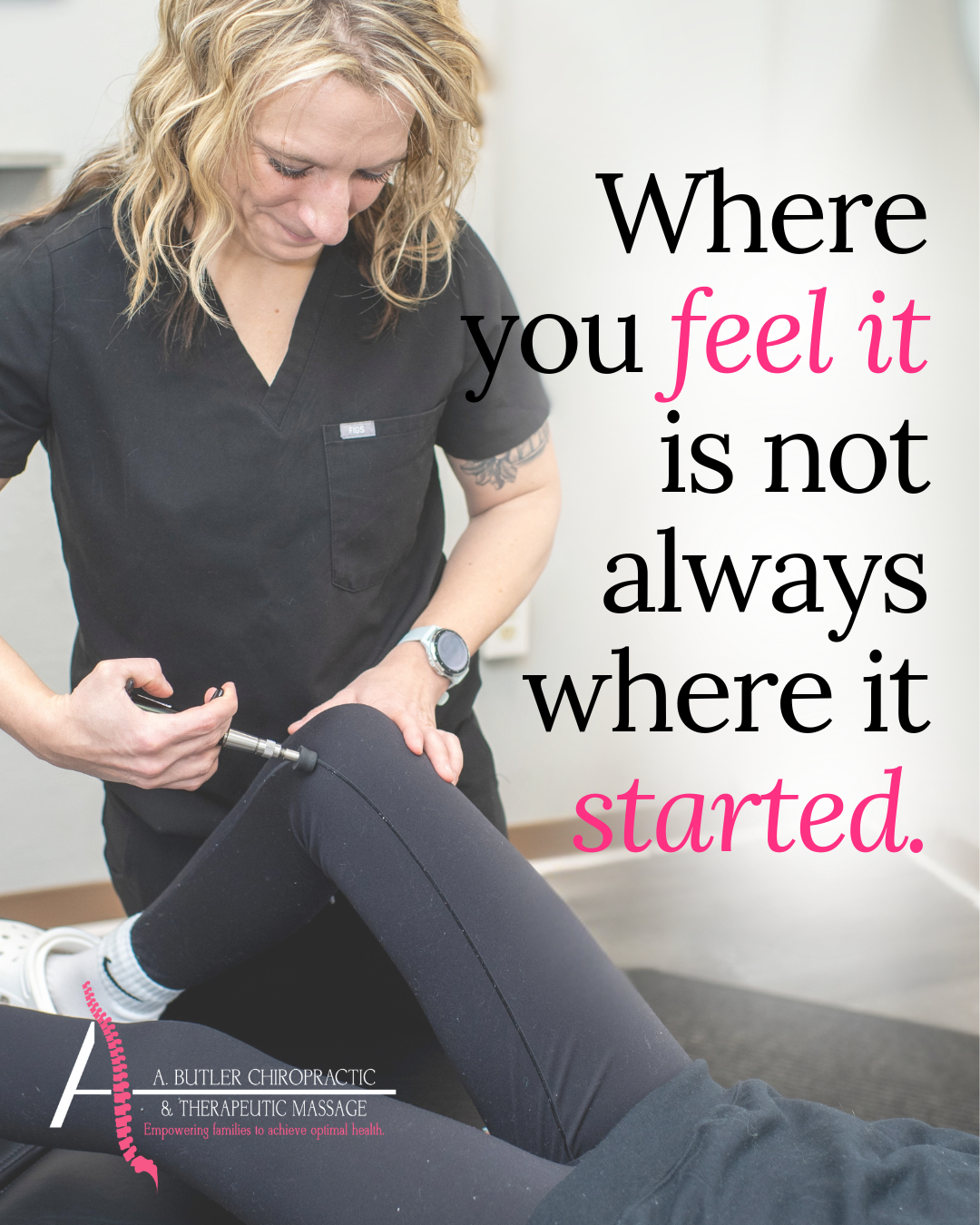
When your foot hurts, of course you think about your foot. Sometimes the issue really is there. But how your ankle moves, how your legs are working, and how you move through your hips and low back can also matter. An old injury, a busy week on your feet, or a change in activity can add another piece to the picture.
That does not mean every foot ache starts in your back. It means we should listen to the whole story before deciding what your body needs.
Think about how you walk when one foot is sore. You might take shorter steps, put more weight on the other side, or avoid pushing off that foot. After a while, another area may start to complain. That does not tell us exactly where the problem began, but it does tell us that looking only at the sore spot could miss something useful.
The same goes for tight legs. Your calves, hamstrings, glutes, and inner thighs all play a part in how you walk, stand, climb stairs, and carry the day’s load. If your knee or hip keeps getting cranky, focusing only on that one sore spot may leave part of the story out.
Maybe you notice your hip after a long drive, your calves after a shift on your feet, or your knee when you take the stairs with a laundry basket. Those details help us understand when discomfort shows up and what may be contributing. “My knee hurts” is the beginning of the conversation, not the whole conversation.
The everyday load adds up in different seasons of life
A new mom may be on her feet while holding and feeding a baby. Another woman is balancing work, teenagers, and aging parents. Someone else finally has more time to hike, travel, garden, or keep up with the grandkids, and wants to feel good doing it.
You carry the baby on one hip while you make lunch with the other hand. You get back into walking or exercise and find that your body did not get the memo about your ambitious new schedule. You spend the weekend in the yard, then return to work Monday as if your legs had the weekend off.
Movement is part of life. But your body responds to what you ask it to do, and sometimes it needs more attention than “I’ll stretch when I remember.”
What wellness care can look like in real life
Wellness care is the choice to check in before the whisper becomes the thing you cannot ignore.
Do I have to be in pain to see a chiropractor? No. Some women come in because something new is bothering them. Others want to stay attentive to a familiar pattern before it becomes disruptive. Both are reasonable. Wellness care can be a conversation about how you are moving, what has changed in your routine, and which small choices may help you feel more comfortable day to day.
Maybe you notice that your feet are sore after every long shift. Maybe your calves keep feeling tight at night, or your hip gets achy after carrying a toddler on the same side all weekend. Those patterns are useful information. They give us a chance to talk about your movement, your daily demands, and what kind of support makes sense for you.
At A. Butler Chiropractic, a visit can include looking at how your joints are moving, what the surrounding muscles are doing, and what may be aggravating the area. Your care is adapted to what you need that day. We may also talk through a few manageable things you can try between visits.
The woman who just worked several long shifts has different needs from someone with a new injury or someone who simply wants to keep enjoying her walks. We can make recommendations, but there is no single schedule that fits every body or every budget. You get to decide what works for your time, your goals, and this season of your life.
Why we look at joints and muscles together
We ask what is going on for you that day. When did the discomfort start? What makes it better or worse? Has the way you move changed? Did you recently change shoes, start a new activity, or have an old injury flare up?
What we find guides the care we recommend. Chiropractic care may address relevant joint movement. Muscle work may help with tension and comfort. We may also talk through practical ways to pace an activity or make room for recovery between busy days. If a concern needs a different kind of evaluation, we will take that seriously too.
Sometimes your legs need more than the leftover minutes
I know why so many women ask for neck and shoulder work first. Between computers, phones, lifting kids, driving, and carrying everything for everybody, those muscles have earned the attention. If you usually book a 30-minute massage, that focused time can be useful.
But if your legs are also bothering you, there may simply not be enough time to do it all in half an hour. Adding another 30 minutes gives your massage therapist room to address the areas you always ask for and spend time with your glutes, hamstrings, calves, and inner thighs.
It may be the first time in a while that your legs have been more than an afterthought in the session. A longer massage does not have to mean a more intense one. You can talk about pressure, an old injury, and any area you would prefer to skip. Some days the best part is focused attention to an overworked muscle. Some days it is having an entire hour where nobody is asking you for anything.
Our massage therapists and chiropractors work alongside one another. When you choose both services, they can coordinate around your goals when appropriate. And if you simply want to book a massage, you can do that too.
What about PEMF for tired feet?
We also offer PEMF on Tuesdays as an optional part of your care. If your feet or ankles feel worn out after too much activity, or an old injury still seems to bother you, we can talk about whether it is a reasonable supportive option for you.
We would rather start with your story than guess at what your foot needs. What are you feeling? What have you already tried? Is the discomfort changing or becoming more persistent? Those answers help us decide whether PEMF belongs in the conversation or whether a different next step makes more sense.
A few questions to ask yourself this week
You do not need to start a detailed symptom journal. Just notice when your feet and legs speak up. Is it after standing, after sitting, first thing in the morning, or after a particular activity? Is it always the same side? Are you changing how you walk to get through the day?
Those answers can help you describe what is happening when you come in. They can also help you recognize when it is time for more than another night of hoping the ache will be gone by morning. New, severe, or worsening pain, marked swelling, or trouble bearing weight deserves prompt medical evaluation.
For the more familiar everyday patterns, bring us the whole story, including the part about how much you are doing and how little time you have to stop. That is part of your care too.
You do not have to earn the appointment
You do a lot. Work, kids, aging parents, home, everyone else’s calendar. It is easy to treat your own care as the thing you schedule only after everything else is handled.
But your body is with you for all of it. If the same foot, knee, or hip keeps speaking up, it is okay to make room for a check-in now. And if you are feeling well and want to stay attentive to how you move and recover, that is a valid reason to come in too.
Maybe your next step is booking the massage and adding time for your legs. Maybe it is coming in to talk about foot pain that keeps returning. Maybe you are feeling good and want to be more intentional about movement and recovery. Those are all reasonable places to start. You do not have to earn an appointment by waiting until you are miserable.
Wellness care can be as simple as listening earlier, getting help when you need it, and making choices that work for your season of life.
If you are ready to talk through what has been bothering you, call 724-822-1828 or book online. We are here in Lyndora, serving women and families in the Butler, PA area.