
Why Does One Shoulder Always Feel Tighter Than the Other?
You know the shoulder.
It creeps toward your ear. The side of your neck feels tight. There is a stubborn knot near the top of your shoulder blade that you keep rubbing throughout the day.
Meanwhile, the other shoulder seems perfectly content.
When neck and shoulder tension repeatedly affects the same side, it may have less to do with one dramatic injury and more to do with the small, one-sided habits you repeat every day.
For many women and moms, those habits are not hard to find. You may carry your toddler on the same hip, sling your bag over the same shoulder, feed your baby in your favorite position, drive with one arm doing most of the work, or sleep curled up on the same side every night.
Your body is wonderfully adaptable, but sometimes one side ends up working overtime.
Why Is One Shoulder Tighter Than the Other?
One-sided neck and shoulder tension can develop when your body repeatedly holds, carries, reaches, or turns in the same direction.
Think about how naturally you choose a favorite side. It is probably the side you use to carry the baby, hold your phone, haul the groceries, pick up a laundry basket, or keep a bag from sliding off your shoulder.
None of those things is necessarily a problem on its own. However, repeating them day after day may ask certain muscles to stay active longer than the muscles on the other side.
Other common contributors may include:
Working at a desk with your screen or keyboard slightly off-center
Looking down at your phone
Holding tension in your shoulders during stressful days
Sleeping with your neck turned or unsupported
Breastfeeding or bottle-feeding in the same position
Carrying children, bags, or work equipment on one side
Driving frequently with the same arm position
Sometimes the tight side is the side doing most of the work. Other times, it is the side trying to compensate for what is happening elsewhere. That is why the place you feel the knot does not always tell us the entire story.
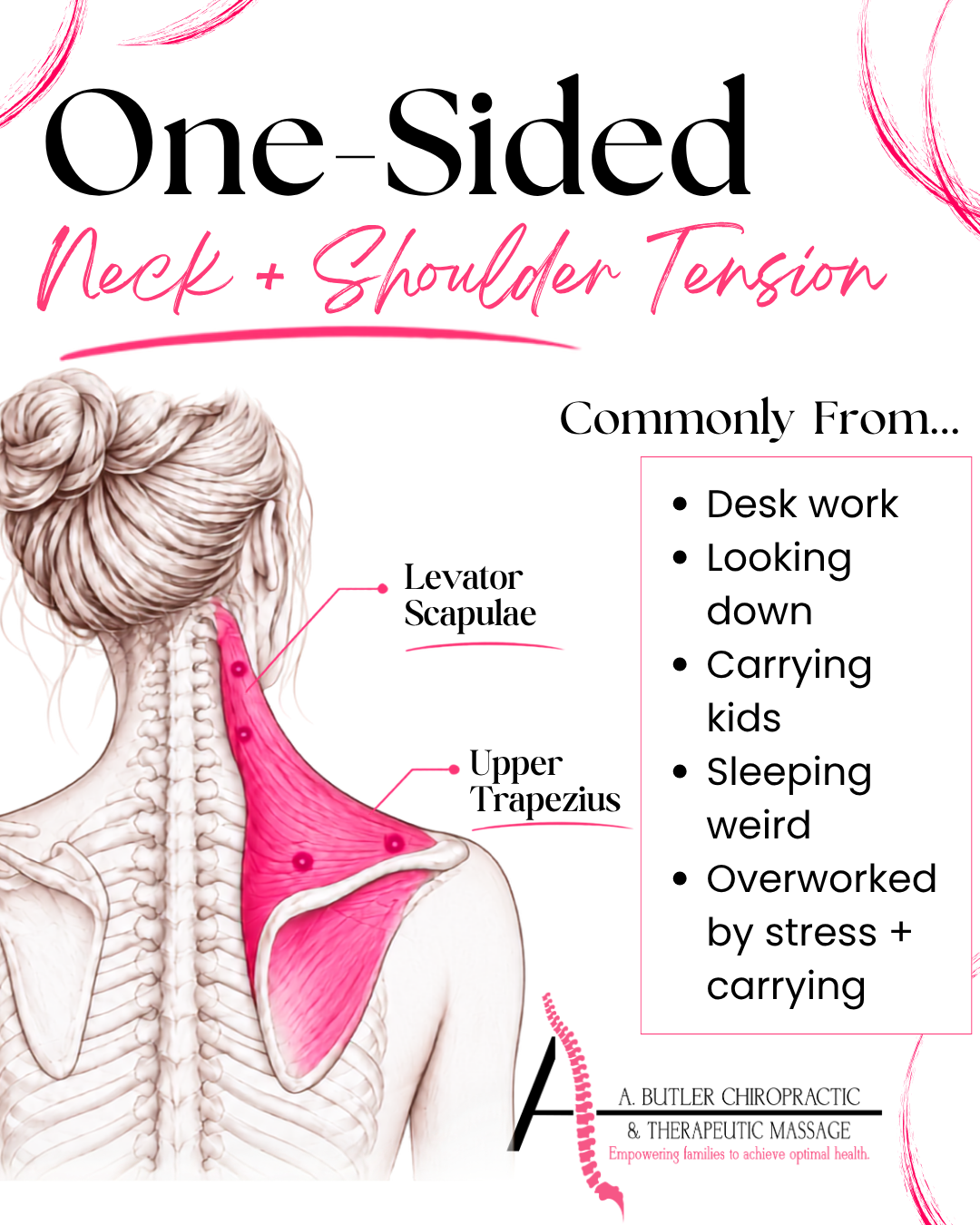
Meet the Levator Scapulae
The levator scapulae is a long, narrow muscle that connects the upper part of your neck to the inner, upper corner of your shoulder blade. Its primary job is right there in its name. It helps elevate, or lift, the shoulder blade. It also assists with movements of the neck.
If you repeatedly carry weight on one side or keep that shoulder slightly lifted, the levator scapulae may spend a great deal of time working.
When it becomes irritated or overworked, you may notice:
A stubborn knot near the top or inside edge of the shoulder blade
Tightness running from your shoulder into your neck
Discomfort when turning your head
A shoulder that feels as if it cannot fully relax
Aching after desk work, driving, feeding a baby, or carrying a child
The constant urge to rub or press the same spot
The levator scapulae is also a common location for sensitive myofascial trigger points, which can cause discomfort locally or in nearby areas.
The Upper Trapezius May Be Helping Too Much
The levator scapulae rarely works alone. The upper trapezius also helps move and stabilize the shoulder blade.
Together, these muscles can create that familiar feeling that your shoulders are living beside your ears.
Stress may add to the pattern. When you are rushing, overwhelmed, concentrating, or bracing through a busy day, your shoulders may gradually rise without you noticing. Add a computer, a phone, a toddler, or a heavy bag, and one side may become your problem child.
This does not automatically mean something is damaged. It may simply mean your body has adapted to the way you use it, and that adaptation is beginning to feel uncomfortable.
Why Rubbing the Knot May Not Be Enough
Pressing on that tight spot can feel wonderful for a moment, but the muscle may tighten again if the movement pattern behind it has not changed.
That is why we do not want to look only at the exact place that hurts.
We may also need to consider:
How your neck is turning
How your upper back and ribs are moving
Whether one shoulder blade is sitting or moving differently
Which muscles are working too hard
Which daily positions keep recreating the tension
Whether the other side of your body is compensating
Your neck, upper back, shoulders, and shoulder blades work together. Addressing only one knot may give you temporary relief, but understanding the larger pattern can help you make more useful changes.
How Massage Therapy May Help
Massage therapy gives your therapist an opportunity to work through the muscles surrounding the neck, shoulders, upper back, and shoulder blades instead of simply pressing on the sorest spot for an entire session.
Massage may provide short-term benefits for some people experiencing neck or shoulder discomfort, although results vary and it is not necessarily more effective than every other active treatment.
At A. Butler Chiropractic, your massage is personalized to how your body feels that day. Your therapist can adjust the pressure, focus, and style of the session based on your comfort and goals.
Sometimes you need focused therapeutic muscle work. Sometimes you need an hour to calm down and let your shoulders finally leave your ears. Most of the time, you may need a little of both.
Where Chiropractic Care Fits
Massage therapy focuses on the muscles and other soft tissues contributing to the tension. Chiropractic care allows us to evaluate how the joints of your neck, upper back, ribs, and shoulders are moving together.
When appropriate, our massage therapists and chiropractors can communicate about the areas they are noticing. This helps your care feel connected instead of feeling like two completely separate services.
You can schedule massage therapy or chiropractic care as a standalone service. You do not need to receive both. However, when your body needs both muscle work and joint care, the services can complement each other while your providers work toward the same goal.
What Can You Do at Home?
A few small changes may help reduce the amount of one-sided work you ask your body to do:
Switch sides when carrying bags or children when it is comfortable and safe.
Support your arms with pillows while feeding a baby.
Bring your phone closer to eye level instead of dropping your head toward it.
Check that your computer screen, keyboard, and chair are centered.
Take brief movement breaks during desk work or long drives.
Notice when stress pulls your shoulders upward, then gently let them relax.
Avoid forcing an aggressive neck stretch or digging deeply into a painful area.
You do not have to make every movement perfectly symmetrical. Bodies are not perfectly symmetrical. The goal is simply to notice the habits that may keep one side working harder than the other.
When Should One-Sided Neck or Shoulder Pain Be Evaluated?
Not every tight shoulder is caused by the levator scapulae or upper trapezius.
Schedule an evaluation if your discomfort is persistent, repeatedly interferes with daily activities, or limits your ability to move your neck or arm. Seek prompt medical attention when neck or shoulder pain follows an accident or occurs with numbness, tingling, weakness, loss of coordination, fever, dizziness, or other unusual symptoms.
Ready to Help That Shoulder Relax?
If the same shoulder always feels tight, you do not have to keep rubbing the same knot and hoping it eventually gives up.
At A. Butler Chiropractic in Lyndora, PA, we offer personalized chiropractic care and therapeutic massage for people throughout Butler and Butler County. You can schedule a massage, a chiropractic appointment, or both, depending on what your body needs.
Book your appointment online or call 724-822-1828.