

3 Common Chiropractic Myths and What Care Actually Looks Like
Chiropractic care is one of those things people often have an opinion about before they have ever experienced it.
Maybe a friend told you that once you start going, you have to keep going forever. Maybe the adjustment videos online made you think every appointment involves loud cracking. Or maybe you assumed chiropractic care was only for someone with severe back pain.
Those ideas are common, but they do not tell the whole story.
At A. Butler Chiropractic in Lyndora, PA, care is personalized around your body, your comfort level, and your goals. You should understand what is being recommended, feel comfortable asking questions, and always have a voice in deciding what makes sense for you.
Let’s clear up three of the most common chiropractic myths.
Myth 1: Once You Start Going to the Chiropractor, You Have to Go Forever
Nope.
Starting chiropractic care does not create a physical dependency on adjustments. Your body does not suddenly forget how to function without a chiropractor.
The frequency and length of care can vary because people come into the office with different needs. Someone who woke up with a stiff neck may have a very different plan than someone who has been dealing with recurring low-back or hip discomfort for several years.
Your chiropractor may recommend a certain frequency based on what you are experiencing, what is found during your evaluation, and what you would like to accomplish. Those recommendations should be explained to you, reviewed as things change, and adjusted when appropriate.
The American Chiropractic Association’s Choosing Wisely recommendations emphasize conversations between chiropractors and patients about which services are appropriate. They also support shared decision-making based on the available information, the chiropractor’s clinical judgment, and the patient’s goals and preferences.
In other words, we will give you our recommendations.
You decide what works for you.
Why Do Some People Continue With Wellness Chiropractic Care?
This is where the myth usually begins.
Some people initially visit a chiropractor because something hurts. Once they are moving more comfortably and feeling better, they may decide to return occasionally rather than waiting until their neck, back, hips, or shoulders start yelling at them again.
That does not mean they are required to continue. It means they have learned how their body tends to feel when they are taking care of it.
There is a difference between coming in because you feel like you desperately need an adjustment and choosing wellness chiropractic care because you prefer how your body feels when regular care is part of your routine.
Some people choose more consistent care. Others schedule when they notice stiffness, changes in movement, or familiar tension returning. Some complete a recommended plan and decide not to continue.
Wellness care is a choice, not an obligation.
Myth 2: Chiropractic Care Is Only for Back Pain
Back pain is one of the most familiar reasons people visit a chiropractor, but it is not the only reason.
According to the American Chiropractic Association, chiropractic is a healthcare profession focused on the musculoskeletal and nervous systems. Chiropractors commonly evaluate concerns involving the back, neck, and joints of the arms and legs.
That means your visit may involve much more than looking at one painful spot in your lower back.
People may visit a chiropractor because they are noticing:
Neck or shoulder tension
Restricted movement
Hip, knee, ankle, wrist, or other joint discomfort
Changes in posture
Muscle tension surrounding a joint
Physical strain from work, exercise, pregnancy, parenting, or everyday life
A recurring movement pattern that no longer feels comfortable
This does not mean chiropractic care is a cure for every symptom or health condition. It means chiropractors are trained to evaluate how joints, muscles, and movement patterns may be contributing to the way someone feels.
Sometimes the area that hurts is only one part of the picture.
That tight neck may also involve your shoulders, upper back, chest, workstation, or the way you hold your phone. Low-back discomfort may be influenced by tension through the hips and glutes. A cranky knee may be affected by how the hip, ankle, and surrounding muscles are working.
Looking at those connections is part of a whole-person approach.
The American Association of Naturopathic Physicians also identifies treating the whole person and supporting prevention as important principles within natural healthcare. While chiropractic and naturopathic medicine are different professions, both recognize that a person is more than one isolated symptom.
Chiropractic Care Can Change With Your Stage of Life
What your body needs may also change over time.
A pregnant woman may need an approach adapted to her changing posture and comfort. A postpartum mom may be dealing with feeding positions, interrupted sleep, carrying a baby, and recovering from pregnancy and birth.
An athlete may be focused on movement and recovery. A teacher may notice neck and shoulder tension after returning to the classroom. A grandparent may simply want to feel more comfortable keeping up with the family.
At A. Butler Chiropractic, we care for women, men, infants, children, teens, pregnant and postpartum clients, athletes, and older adults throughout Butler County.
The approach should never look exactly the same for everyone.
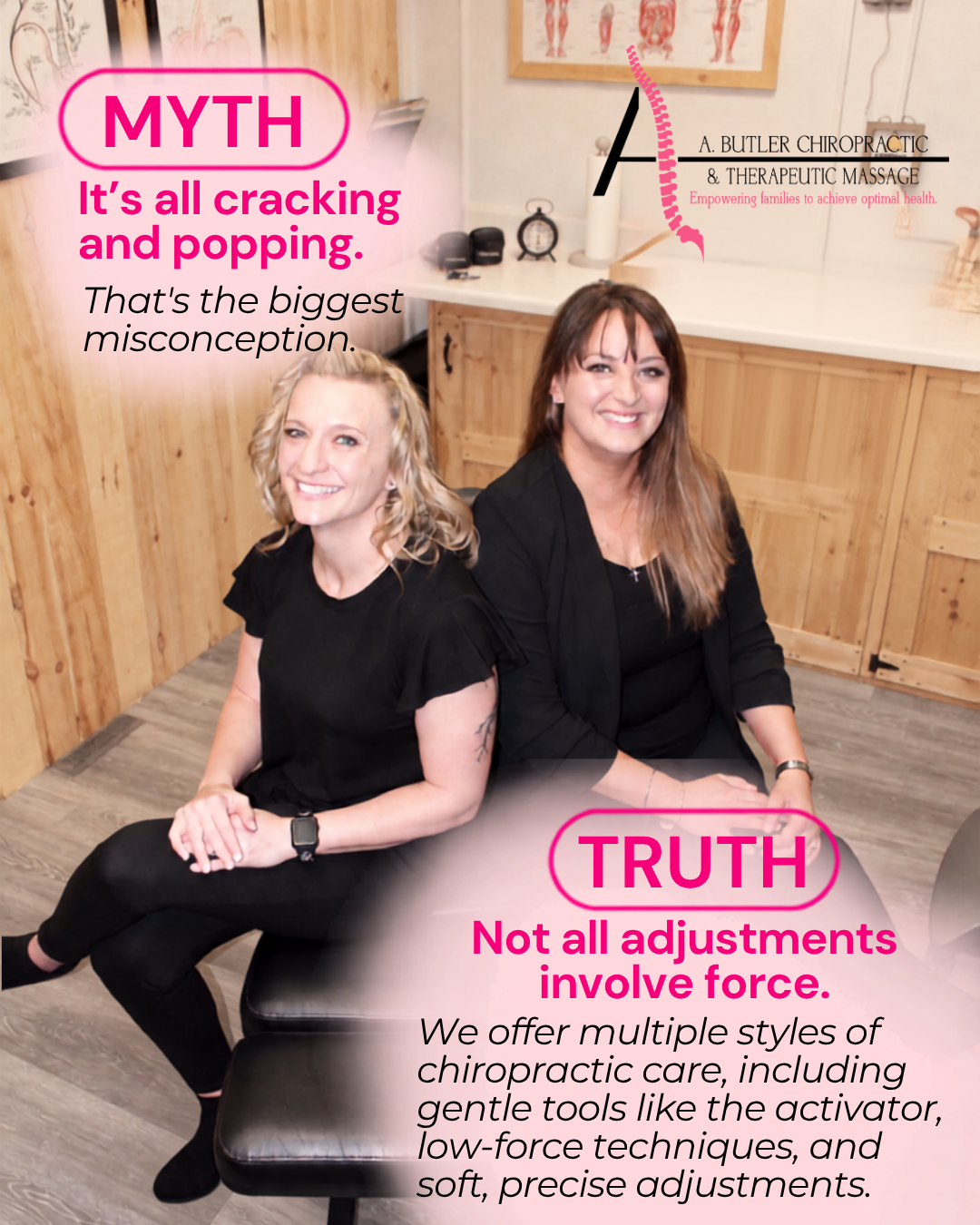
Myth 3: Every Chiropractic Adjustment Is Forceful, Painful, or Loud
When people picture a chiropractic adjustment, they often imagine a dramatic twisting movement followed by a loud crack.
Real chiropractic care is much more adaptable than what you may see in a short online video.
The popping sound that sometimes happens during an adjustment is not the goal of the adjustment. It is a sound associated with changes inside a joint. A louder sound does not automatically mean that an adjustment was more successful, and the absence of a sound does not mean that nothing happened.
The University of Bridgeport School of Chiropractic explains that the familiar pop is an occasional byproduct of some procedures rather than the purpose of care.
There are also many different chiropractic techniques. Some use a manual adjustment, while others use a specialized table, an instrument, lighter pressure, or a slower approach.
Palmer College of Chiropractic describes a wide range of techniques taught within chiropractic education, including manual adjustments, instrument-assisted methods, flexion-distraction, soft-tissue approaches, and gentle, low-force techniques.
Your age, stage of life, comfort level, health history, and reason for visiting can all influence which approach is used.
If there is a technique you do not like, tell us.
If you are nervous about having your neck adjusted, tell us.
If you prefer a gentler approach, tell us.
You should never feel embarrassed about asking questions or expressing a preference. A good chiropractic visit is a conversation, not something that simply happens to you.
What Does Personalized Chiropractic Care Actually Look Like?
A chiropractic appointment should begin with listening.
Before deciding what care may be appropriate, your chiropractor needs to understand what you are experiencing, how long it has been happening, what seems to make it better or worse, and what you hope to change.
An evaluation may include looking at posture, joint movement, muscle tension, balance, or functional movement. Your chiropractor can then explain what they are noticing and discuss options with you.
At our office, a visit may include:
A chiropractic adjustment adapted to your comfort level
Focused muscle work
Gentle movement or stretching
Discussion of everyday activities that may be contributing to tension
Collaboration with one of our massage therapists when both muscle and joint care may be helpful
Not every person needs every service, and not every visit needs to look exactly the same.
The goal is thoughtful care that meets you where you are.
Do I Have to Keep Seeing a Chiropractor Forever?
No. Your chiropractor may recommend a plan based on your evaluation and goals, but you decide whether and how you continue care.
Does an Adjustment Have to Make a Popping Sound to Work?
No. The sound is not the goal or the measure of an adjustment. Many chiropractic techniques use little force and may not create a noticeable sound.
Can I Visit a Chiropractor if My Back Does Not Hurt?
Yes. Chiropractors evaluate concerns involving joints, muscles, mobility, posture, and movement throughout the body. Whether chiropractic care is appropriate for your specific concern is determined through your history and evaluation.
Can I Ask for a Gentler Chiropractic Technique?
Absolutely. Tell your chiropractor about your comfort level, past experiences, and concerns. Your preferences should be part of the conversation when planning your care.
Chiropractic Care Should Never Feel Like Pressure
You should never feel pressured to commit to endless appointments or agree to an adjustment you do not understand.
Our job is to listen, evaluate, explain what we are noticing, and give you our recommendations. Your job is to decide what fits your goals, your schedule, your comfort level, and your life.
Some people come to us because their body is yelling.
Others decide they would rather listen while it is still whispering.
Neither choice locks you into chiropractic care forever. It simply gives you another option for supporting how your body moves and feels.
If you are looking for personalized chiropractic care in Lyndora, Butler, or the surrounding Butler County communities, call A. Butler Chiropractic at 724-822-1828 or book online.