

By the time you pull into the driveway, you can feel an ache creeping up the back of your head. You reach over to grab your water bottle and realize it’s just as heavy as it was when you left the house this morning. You remembered to tell your kids to take theirs, though. Funny how that works.
It’s easy to blame the water bottle, the weather, or the way you slept last night. Sometimes one of those guesses is right. What I’m more interested in is the part you might leave out when you tell me about your headache. Did your head already hurt when you woke up? Did it start halfway through a long drive, when turning to check your blind spot felt uncomfortable? Or was your neck feeling fine until the headache was already underway?
Those details help Dr. Jess and me figure out whether chiropractic care might help, whether your neck muscles deserve some attention first, or whether the pattern calls for a different kind of evaluation.
Why do headaches show up on certain days?
Think about a day when lunch gets pushed from noon to two, then two becomes school pickup. You’ve had coffee, barely touched your water, and spent most of the afternoon squinting at a spreadsheet. If you’re prone to migraine, missed meals, too little fluid, changes in sleep, and stress can all make an attack more likely. Some women notice a pattern around their period, too. You can take good care of yourself and still have migraine. Knowing your patterns simply gives you somewhere to start.
Then there’s what your muscles were doing during that same afternoon. When an email needs a carefully worded reply, I’d bet plenty of us could pause mid-sentence and find our teeth pressed together. Maybe you lean toward the monitor every time the print gets small. Or you finally sit down after dinner and spend another half hour looking down at your phone, catching up on everything you missed while you were at work. The most helpful question may be, “When did I last give my neck a chance to move?”
Even the headache you call your “allergy headache” is worth describing in your own words. Tell us if your nose is stuffy, where you feel the pressure, and whether light or noise bothers you. And if your headaches tend to come with nausea or make you want to lie down in a dark room, mention that. It gives your provider a much clearer picture than the word “pressure” alone.
Can tight neck muscles cause a headache at the base of your skull?
They can contribute. The little muscles you feel just below the back of your skull are called the suboccipitals. They help guide small head movements, like tipping your chin up a little to see through the right part of your glasses. The joints in your upper neck and the tissues around them can also refer pain into your head. A headache that starts in the neck is called a cervicogenic headache. Sometimes the ache travels from the base of the skull toward one temple or behind one eye. Turning your head a particular way may bring on that familiar pain.
A sore neck by itself doesn’t tell us where a headache started. If your neck stiffens every time you have a migraine, that’s worth knowing. If backing the car out of the garage reliably brings on the same ache before your head even starts hurting, that’s worth knowing, too. You don’t have to figure out the diagnosis before you come in. Just tell us which part happens first.
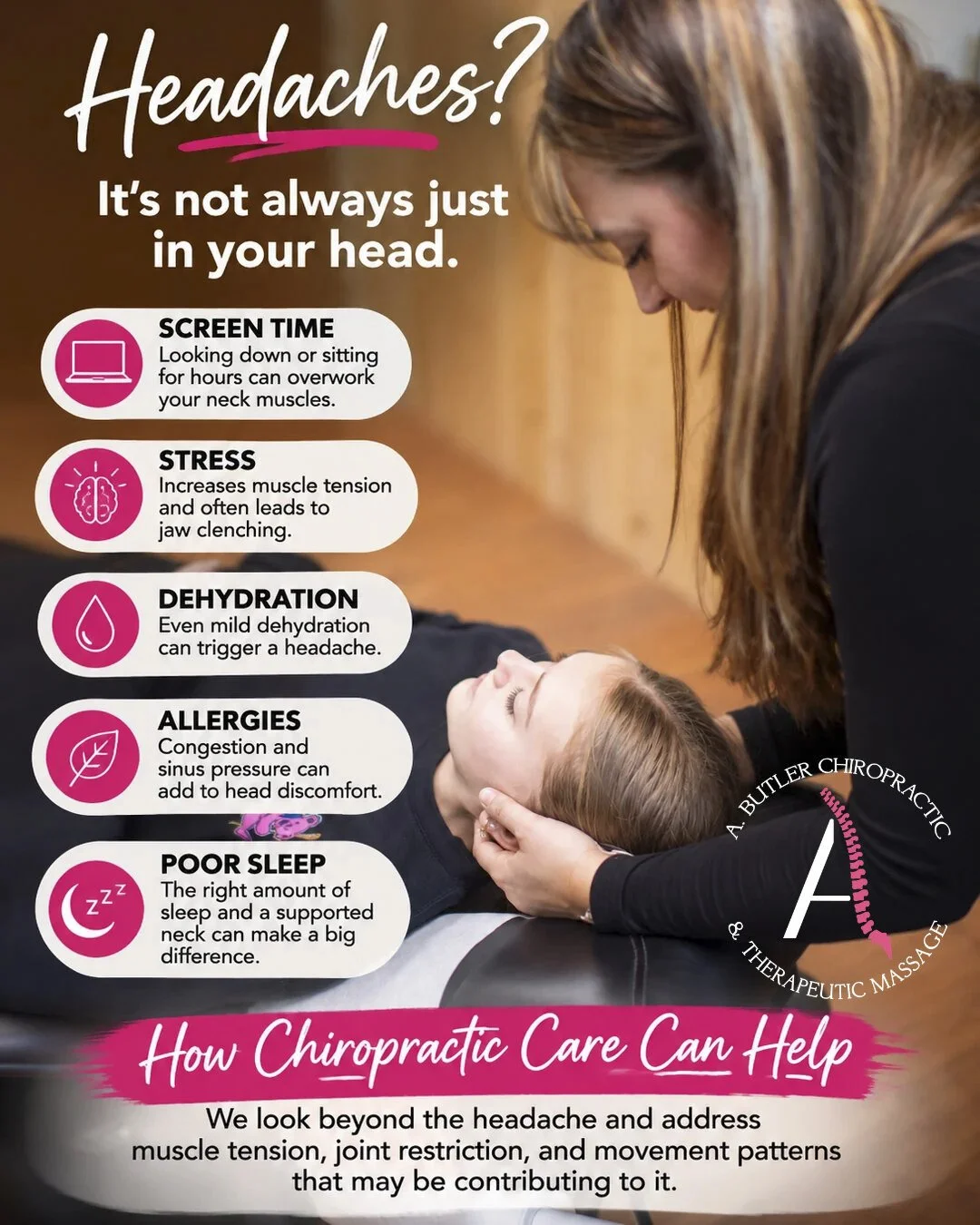
How can chiropractic care help headaches?
When your history and exam point to a headache coming from your neck, chiropractic care may help it hurt less or happen less often. Research on this particular type of headache supports hands-on treatment, including joint mobilization or manipulation, and targeted exercises. Results vary, and some of the studies have limitations. That’s why we pay attention to how your headaches change over time.
At A. Butler Chiropractic, we’ll ask you to show us the movement that bothers you. We look at how comfortably your neck turns and what happens in your shoulders and upper back as you move. When an adjustment makes sense, we’ll explain what we’re working on and choose a technique you’re comfortable with. We may also work on the surrounding muscles or practice a movement you can use during the part of the day that tends to bother you most.
One question I like for a follow-up is, “How was the drive home this week?” If you can check traffic more comfortably, or you’ve made it through three afternoons without the headache that usually shows up by four, that tells us more than whether your neck felt looser for ten minutes after your visit.
Should you get a massage before your adjustment?
Sometimes, yes. If you’re lying face down on the table and still holding your shoulders up around your ears, it can feel uncomfortable just to let someone move your head. On a day like that, it may make sense to start with massage. Your therapist can spend time on your upper back and shoulders, then work gently around the base of your skull at a pressure that feels comfortable. Afterward, we can see how your neck moves and decide together whether an adjustment makes sense that day.
Dr. Jess and I were both massage therapists before we became chiropractors, so this part of the visit matters to us. Some days a few minutes of focused muscle work during your chiropractic visit is plenty. Other days you might prefer a dedicated massage first, especially when you can feel the tension from your jaw all the way down between your shoulder blades. If you book both, tell your therapist the same detail you told your chiropractor, even if it seems small. “My headache starts here when I turn to the left” gives us a better starting point than “my whole neck is tight.”
What can you change before the next headache shows up?
Start with the part of your day that keeps repeating. If you lean forward to read at work, try making the type bigger and see whether you settle back into your chair. If school pickup is usually the first time you remember lunch, pack something for yourself while you’re packing everyone else’s. If you wake up sore, notice whether your pillow leaves your head tipped sharply to one side. Pick one change that fits your actual day and see what you notice.
For a week or two, a quick note on your phone can help. Something as simple as “Tuesday, 3 p.m., neck tight first, missed lunch” is enough. Include your period, a rough night of sleep, or an unusually stressful day when it seems relevant. You’re looking for a repeat, and it’s okay if you don’t find one.
What if you’re pregnant or recently had a baby?
During pregnancy, a new sleeping position can leave your neck uncomfortable. After delivery, you might spend a good part of the night looking down at a little face while you feed your baby. Supporting your arms with a pillow and giving yourself permission to look up every so often are small comforts worth trying. A new headache during pregnancy or after delivery deserves a prompt call to your maternity care team. Seek immediate medical care if it’s severe, keeps getting worse, won’t go away, or comes with vision changes. At any stage of life, a sudden, explosive headache or one with new weakness or trouble speaking needs emergency care.
If a familiar headache keeps interrupting your afternoon and your neck always seems to be part of the story, we’d like to hear how it starts. Call A. Butler Chiropractic at 724-822-1828 or book online HERE for a visit at our office in Lyndora, near Butler, PA.