
Vertigo and Chiropractic Care: Why This Topic Is Personal for Dr. Amber
Understanding Vertigo
Vertigo is one of those symptoms that can be difficult to fully understand unless you have experienced it yourself. It is more than feeling a little lightheaded or off balance. Vertigo can make it feel like the room is spinning, the floor is moving, or your body cannot quite figure out where it is in space.
For some people, vertigo happens suddenly and passes quickly. For others, it can become a recurring issue that interferes with normal daily activities. Something as simple as rolling over in bed, turning your head, looking up, or standing too quickly can trigger symptoms.
Because vertigo can feel so unsettling, it often creates anxiety around movement. Many people begin avoiding certain positions or activities because they are afraid of setting off another episode. Over time, that can lead to more tension through the neck, shoulders, and upper back, which may add another layer to the problem.
Why Vertigo Matters to Dr. Amber
This topic is personal for Dr. Amber because vertigo is actually one of the reasons she became a chiropractor.
When she was 16 years old, she experienced severe vertigo symptoms. At the time, instead of getting clear answers, her family was told that she must have been making it up. That experience stayed with her, not only because the symptoms were so disruptive, but because she knew what she was feeling was real.
Since then, Dr. Amber has found different ways to manage and reduce her vertigo symptoms. Regular chiropractic care and massage therapy helped decrease the majority of her symptoms over time. That relief played a major role in her decision to become both a massage therapist and a chiropractor.
Her own experience shaped the way she listens to patients. When someone comes in feeling dizzy, off balance, or unsure of what is going on with their body, those symptoms are taken seriously. Vertigo can be frustrating, scary, and hard to explain, and patients deserve to feel heard.
What Is Vertigo?
Vertigo is a symptom that creates the sensation of spinning, tilting, or movement when you are not actually moving. It is commonly connected to the vestibular system, which includes parts of the inner ear and brain that help control balance and spatial awareness.
Common symptoms associated with vertigo may include dizziness, nausea, balance problems, motion sensitivity, lightheadedness, or feeling unsteady. Some people notice symptoms with certain head positions, while others feel generally off throughout the day.
It is important to understand that vertigo itself is not a diagnosis. It is a symptom that can have different causes. Some cases are related to the inner ear. Others may be connected to migraines, inflammation, previous injuries, nervous system stress, or neck dysfunction.
That is why a proper evaluation matters. The goal is not only to calm the symptoms down, but also to understand what may be contributing to them.
The Inner Ear and the Epley Maneuver
One common cause of vertigo is benign paroxysmal positional vertigo, often called BPPV. With BPPV, tiny crystals in the inner ear shift into an area where they do not belong. When this happens, certain head movements can trigger a spinning sensation.
For this type of vertigo, the Epley maneuver is often used. This maneuver involves a specific sequence of head and body positions designed to help move those crystals back where they belong.
Dr. Amber has personally found relief using the Epley maneuver when her symptoms matched that pattern. Today, more people are aware of this option, and many local facilities also offer vestibular physical therapy for vertigo and balance concerns.
That is one of the biggest messages we want people to understand: you do not have to simply suffer through vertigo. There are different forms of care that may help, depending on what is causing your symptoms.
How the Neck Can Be Involved in Dizziness
Not every case of vertigo comes from the neck, and not every person with dizziness needs chiropractic care. However, the neck can play a role for some people.
The joints, muscles, and nerves in the neck provide important information to the brain about head position and movement. When the neck is restricted, irritated, or holding excess tension, that communication may become less clear.
Some people experience dizziness along with neck pain, headaches, stiffness, or limited range of motion. This is sometimes referred to as cervicogenic dizziness, meaning dizziness that may be connected to dysfunction in the cervical spine.
In these cases, evaluating the neck can be an important part of understanding the full picture. If the upper cervical spine is not moving well, or if the muscles around the base of the skull are tight and guarded, the body may have a harder time feeling balanced and coordinated.
Why Chiropractic Care May Help
Chiropractic care focuses on improving joint movement, reducing nervous system irritation, and helping the body function with better communication between the brain and the rest of the body.
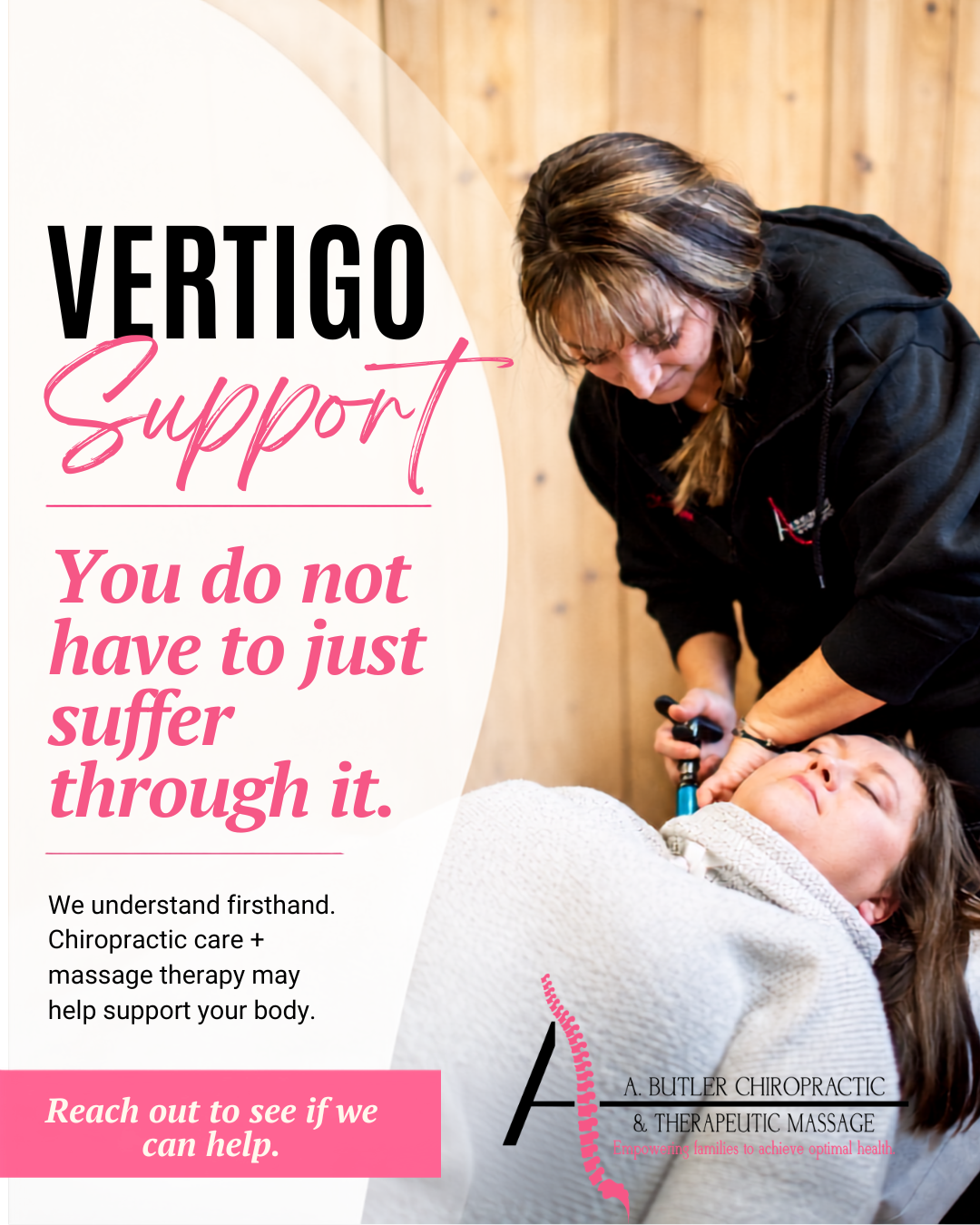
For patients dealing with dizziness or vertigo-like symptoms related to neck dysfunction, chiropractic care may help by improving motion through the cervical spine and decreasing tension in surrounding areas. The goal is not to force the body into a change, but to support better function and help reduce the strain that may be contributing to symptoms.
At A. Butler Chiropractic & Therapeutic Massage, care is always individualized. We look at how your neck is moving, where tension is building, what positions make symptoms worse, and whether your symptoms suggest that another type of care or referral may be needed.
Sometimes chiropractic care is part of the solution. Sometimes vestibular physical therapy is needed. Sometimes both can be helpful. The most important part is making sure the care plan matches what your body is actually showing us.
Why Massage Therapy Can Be Part of the Conversation
Massage therapy can also be helpful for people who experience vertigo or dizziness along with neck and shoulder tension.
When vertigo happens, the body often starts to guard. You may hold your head differently, avoid turning your neck, tense your shoulders, or brace without realizing it. Over time, that protective pattern can create more tightness through the neck, jaw, upper back, and shoulders.
Therapeutic massage can help calm overworked muscles, reduce tension, and improve comfort through the areas that may be compensating. When paired with chiropractic care, massage therapy can support both the joints and the soft tissues that influence how the neck and upper body move.
This is one of the reasons our office values the combination of chiropractic care and therapeutic massage. The body is not separated into isolated parts. Muscles, joints, nerves, posture, stress, and movement patterns all work together.
When Vertigo Should Be Evaluated Right Away
While many cases of vertigo are not life-threatening, some symptoms should never be ignored. If dizziness or vertigo comes on suddenly or is accompanied by serious symptoms, medical evaluation is important.
Seek urgent medical care if vertigo is accompanied by sudden severe headache, chest pain, difficulty speaking, facial drooping, weakness or numbness on one side of the body, vision changes, fainting, confusion, trouble walking, recent head injury, or sudden hearing loss.
These symptoms may point to something more serious and should be addressed immediately.
You Deserve to Be Heard
One of the hardest parts of dealing with vertigo is how isolating it can feel. Because other people cannot always see what you are feeling, it may be dismissed or misunderstood.
Dr. Amber’s own experience is part of why she feels so strongly about this topic. Being told that symptoms are “made up” when your body feels completely out of control is frustrating and discouraging. Patients deserve better than that.
If you are experiencing vertigo, dizziness, balance issues, neck tension, or headaches, your symptoms deserve attention. They deserve to be explored thoughtfully. And you deserve to have someone listen.
Finding the Right Support for Vertigo
Vertigo can have different causes, which means there is no single approach that works for everyone. For some people, the Epley maneuver may be helpful. For others, vestibular physical therapy may be the right fit. For those whose symptoms are connected with neck tension, restricted movement, or nervous system stress, chiropractic care and massage therapy may provide meaningful support.
The key is identifying what your body needs.
At A. Butler Chiropractic & Therapeutic Massage, we take a whole-body approach. We look at how your neck is moving, how your muscles are responding, how your nervous system may be adapting, and whether additional referral or co-care would be beneficial.
Our goal is to help you feel more steady, more supported, and more confident in your body again.
The Bottom Line
Vertigo can be scary, disruptive, and exhausting. It can affect your balance, your confidence, your movement, and your daily life.
But you do not have to just live with it.
For Dr. Amber, chiropractic care and massage therapy made such a difference in her own vertigo journey that they became part of the reason she chose this profession. Now, her goal is to help others feel heard, supported, and guided toward care that makes sense for their body.
If you have been struggling with vertigo, dizziness, neck tension, headaches, or that uncomfortable feeling that something is just “off,” reach out and see if we can help.
Book online HERE or call 724-822-1828 to schedule an appointment with A. Butler Chiropractic & Therapeutic Massage.