
Shoulder Pain Traveling Down Your Arm? Your Rotator Cuff May Be Part of the Problem
When Shoulder Pain Does Not Stay in the Shoulder
Shoulder pain can be confusing because it does not always stay in one neat, obvious place. Sometimes it feels like a deep ache in the shoulder joint. Sometimes it shows up when you reach overhead, put on a coat, lift groceries, or try to sleep on that side. And sometimes, it travels down the arm in a way that makes you wonder if the problem is actually coming from somewhere else.
This is one of the reasons rotator cuff pain can be so frustrating. The rotator cuff is part of the shoulder, but when those muscles or tendons become irritated, the discomfort may be felt at the shoulder joint, along the upper arm, and sometimes farther down the arm. Mayo Clinic describes rotator cuff injuries as a common cause of shoulder aching, especially pain that can worsen at night, while Cleveland Clinic notes that rotator cuff-related shoulder problems can create pain with movement, weakness, and difficulty using the arm normally.
So if you have been rubbing your arm, stretching your neck, shaking out your hand, or wondering why your shoulder pain keeps moving around, your rotator cuff may need to be part of the conversation.
What the Rotator Cuff Actually Does
The rotator cuff is a group of muscles and tendons that help stabilize the shoulder. Your shoulder is one of the most mobile joints in the body, which is helpful when you are reaching, lifting, carrying, pushing, pulling, driving, cleaning, working, or trying to get something off the top shelf.
But that mobility comes with a tradeoff. Because the shoulder moves so much, it depends heavily on the muscles around it for control and support. The rotator cuff helps keep the upper arm bone centered in the shoulder socket as you move. When the rotator cuff is working well, you probably do not think about it at all. When it is irritated, overworked, weak, tight, or inflamed, simple movements can start to feel uncomfortable.
That is when everyday tasks begin to feel like a problem. Reaching into the back seat. Buckling a child into a car seat. Blow drying your hair. Putting away dishes. Sleeping on your side. Pulling a shirt over your head. These are not “big” movements, but when the shoulder is not functioning well, they can become very noticeable.
Why Rotator Cuff Pain Can Travel Down the Arm
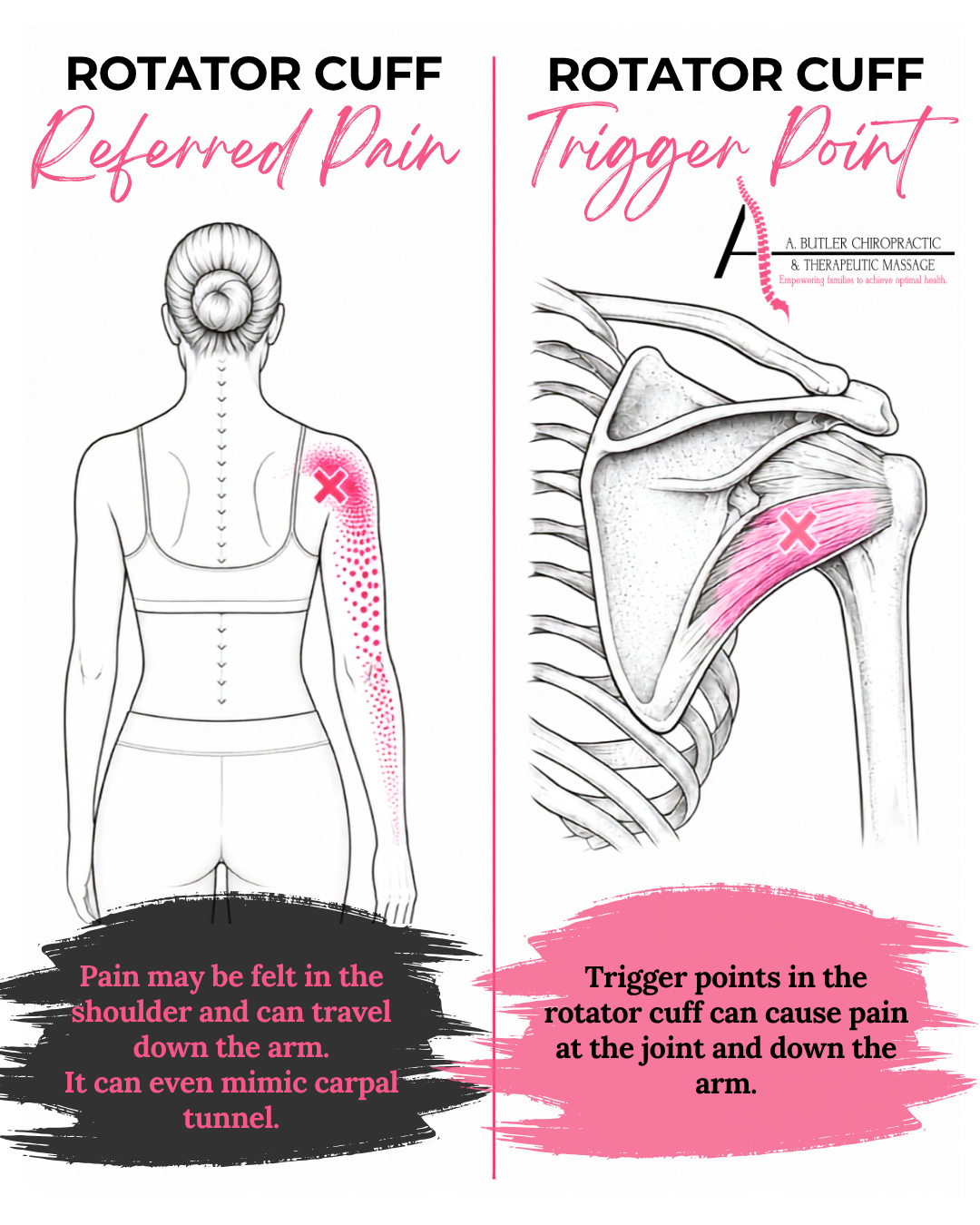
One thing many people do not realize is that pain does not always show up exactly where the problem begins. Muscles can create referred pain patterns, meaning an irritated area may send discomfort somewhere else. Trigger points in the shoulder and rotator cuff muscles can contribute to shoulder pain and symptoms that feel like they travel into the arm. Research on myofascial shoulder pain has looked at how trigger points in the shoulder region can contribute to pain patterns and functional limitations.
This is why a rotator cuff issue may feel like more than just shoulder pain.
It may feel like an ache down the outside of the arm. It may feel like a deep joint pain. It may feel like the shoulder catches or pinches when you lift your arm. It may even feel like something is going on closer to the elbow, wrist, or hand.
That does not mean every arm symptom comes from the rotator cuff. Neck irritation, nerve involvement, wrist issues, and other conditions can also cause symptoms into the arm or hand. But it does mean that when shoulder and arm pain show up together, it is important to look at the bigger picture instead of only chasing the spot that hurts the most.
Why It Can Feel Like Carpal Tunnel
Sometimes people come in describing pain, aching, tightness, or odd sensations down the arm and immediately wonder if it is carpal tunnel. That makes sense, especially if symptoms are showing up near the hand or wrist. But not every arm symptom starts in the wrist.
The shoulder, neck, upper back, ribs, and surrounding muscles all influence how the arm feels and functions. If the rotator cuff is irritated, if the shoulder blade is not moving well, or if the neck and upper back are compensating, the entire arm can start to feel “off.”
This is why we do not want to guess. We want to evaluate how the shoulder is moving, how the neck is moving, what muscles are guarding, where the pain is referring, and whether there are signs of nerve involvement. The goal is not just to name the symptom. The goal is to understand where it is coming from.
How Rotator Cuff Problems Build Over Time
Rotator cuff pain can happen after a specific injury, like a fall, heavy lift, sudden pull, or sports-related movement. But very often, it builds gradually.
For many people, it comes from the accumulation of normal life. Desk work. Mouse use. Driving. Yard work. Painting. Cleaning. Carrying kids. Lifting groceries. Sleeping on the same side every night. Working overhead. Repetitive workouts. Stress that keeps the shoulders tense. Posture habits that have been building for years.
One single thing may not seem like enough to cause shoulder pain. But repeated stress over time can change how the shoulder moves and how the muscles support it. Eventually, the rotator cuff may start doing too much, the shoulder blade may stop gliding well, and the neck and upper back may begin to compensate.
By the time pain shows up, the pattern may have been building for a while.
Why We Look Beyond the Shoulder Joint
At A. Butler Chiropractic & Therapeutic Massage, we do not look at the shoulder as an isolated body part. The shoulder works with the neck, upper back, ribs, shoulder blade, and nervous system. When one part of that system is not moving well, another area often steps in to help.
That is why rotator cuff pain is not always just a rotator cuff problem.
A tight neck can change shoulder mechanics. Restricted upper back movement can affect how the shoulder blade moves. Tight chest muscles can pull the shoulder forward. Trigger points can refer pain down the arm. Stress can keep the muscles guarded. And if the body keeps protecting the area, that protective tension can become part of the problem.
This is why a combined approach can be so helpful. Chiropractic care can support better joint movement through the spine, ribs, and shoulder region. Therapeutic massage can address muscle tension, trigger points, guarding, and the soft tissue restrictions that may be contributing to the pain pattern.
The goal is not just to make the shoulder feel better for a day. The goal is to help the shoulder move better, reduce unnecessary tension, and support the body so it does not keep falling back into the same pattern.
What Rotator Cuff Pain May Feel Like
Rotator cuff pain can look different from person to person, but there are some common patterns. Many people notice pain with reaching overhead, lifting the arm out to the side, reaching behind the back, or lying on the affected shoulder. Some feel weakness or fatigue when using the arm. Others describe a dull ache that becomes sharper with certain movements.
Pain at night is also common with rotator cuff irritation. If you roll onto the sore shoulder or sleep with your arm in an awkward position, it may wake you up or leave you stiff in the morning. Mayo Clinic notes that rotator cuff injuries may cause a dull shoulder ache that worsens at night.
And then there is the referred pain pattern. This is where the shoulder may hurt, but the discomfort also seems to travel into the arm. That traveling pain is often what makes people nervous, because it does not feel simple. It feels like the body is giving mixed signals.
That is exactly why it is worth being evaluated.
When You Should Get Shoulder and Arm Pain Checked
Not every shoulder ache is an emergency, but pain that keeps returning should not be ignored. If your shoulder pain is traveling down your arm, affecting your sleep, limiting your range of motion, or making normal daily tasks difficult, it is time to have someone look at it.
It is especially important to get checked if you have weakness, numbness, tingling, loss of grip strength, pain after a fall, sudden inability to lift the arm, or symptoms that are getting worse instead of better. Shoulder and arm pain can come from several different sources, and the right care plan depends on understanding what is actually driving the symptoms.
And as always, if arm pain is accompanied by chest pain, shortness of breath, dizziness, sweating, jaw pain, or other concerning symptoms, that needs immediate medical attention.
How Chiropractic Care and Therapeutic Massage Can Help
For rotator cuff-related shoulder pain, care should be specific to the person. The same shoulder complaint can have different causes depending on someone’s posture, work, activity level, stress, injury history, sleep position, and movement patterns.
In our office, we look at how the shoulder is functioning as part of the whole body. We may assess the neck, upper back, ribs, shoulder blade movement, muscle tension, and the way the arm moves through different ranges. From there, care may include gentle chiropractic adjustments, therapeutic massage, soft tissue work, trigger point work, mobility support, and simple home recommendations.
This is also where therapeutic massage makes a big difference. Massage in this setting is not just about relaxation, although feeling more relaxed is definitely a welcome bonus. Therapeutic massage is focused on helping the muscles function better, calming areas of tension, and addressing the soft tissue patterns that may be contributing to pain.
For someone with rotator cuff trigger points or referred shoulder pain, that kind of targeted muscle work can be an important piece of the plan.
Shoulder Pain Help in Lyndora and Butler, PA
If you are searching for help with rotator cuff pain in Butler, PA, shoulder pain treatment near Lyndora, therapeutic massage for shoulder pain, or chiropractic care for pain traveling down the arm, we would love to help you understand what is going on.
A. Butler Chiropractic & Therapeutic Massage is located in Lyndora, PA and serves families throughout Butler and the surrounding greater Pittsburgh area. The office offers chiropractic care, massage, and holistic wellness support at 6 Chesapeake St., Suite 205, Lyndora, PA 16045.
Shoulder pain can be frustrating, especially when it starts affecting your sleep, your work, your workouts, or the basic daily things you need to do. But you do not have to keep guessing where it is coming from or hoping it eventually goes away.
If your shoulder pain is traveling down your arm, mimicking carpal tunnel, or making normal movement uncomfortable, it may be time to take a closer look at your rotator cuff, your trigger points, and the way your shoulder is functioning as a whole.
Book online HERE or call 724-822-1828 to schedule an appointment with A. Butler Chiropractic & Therapeutic Massage.