
Jaw Clenching and Masseter Tension: When Your Jaw Has Been Carrying Too Much Stress
Sometimes you do not realize how much tension you are holding until someone reminds you to unclench your jaw.
Take a moment and check right now. Are your teeth touching even though you are not eating? Does your tongue feel tense or pressed firmly against the roof of your mouth? Have your shoulders slowly crept toward your ears?
For many people, jaw clenching happens so automatically that they do not notice it until the muscles become tired, sore, or uncomfortable. You may clench while concentrating at work, driving through traffic, scrolling on your phone, exercising, or trying to manage a stressful day. Other people grind or clench their teeth while sleeping and only become aware of it when a dentist notices tooth wear or they begin waking up with jaw discomfort.
When this pattern continues, the muscles that help you chew can end up working far more than they were designed to. One of the main muscles involved is the masseter.
What Is the Masseter Muscle?
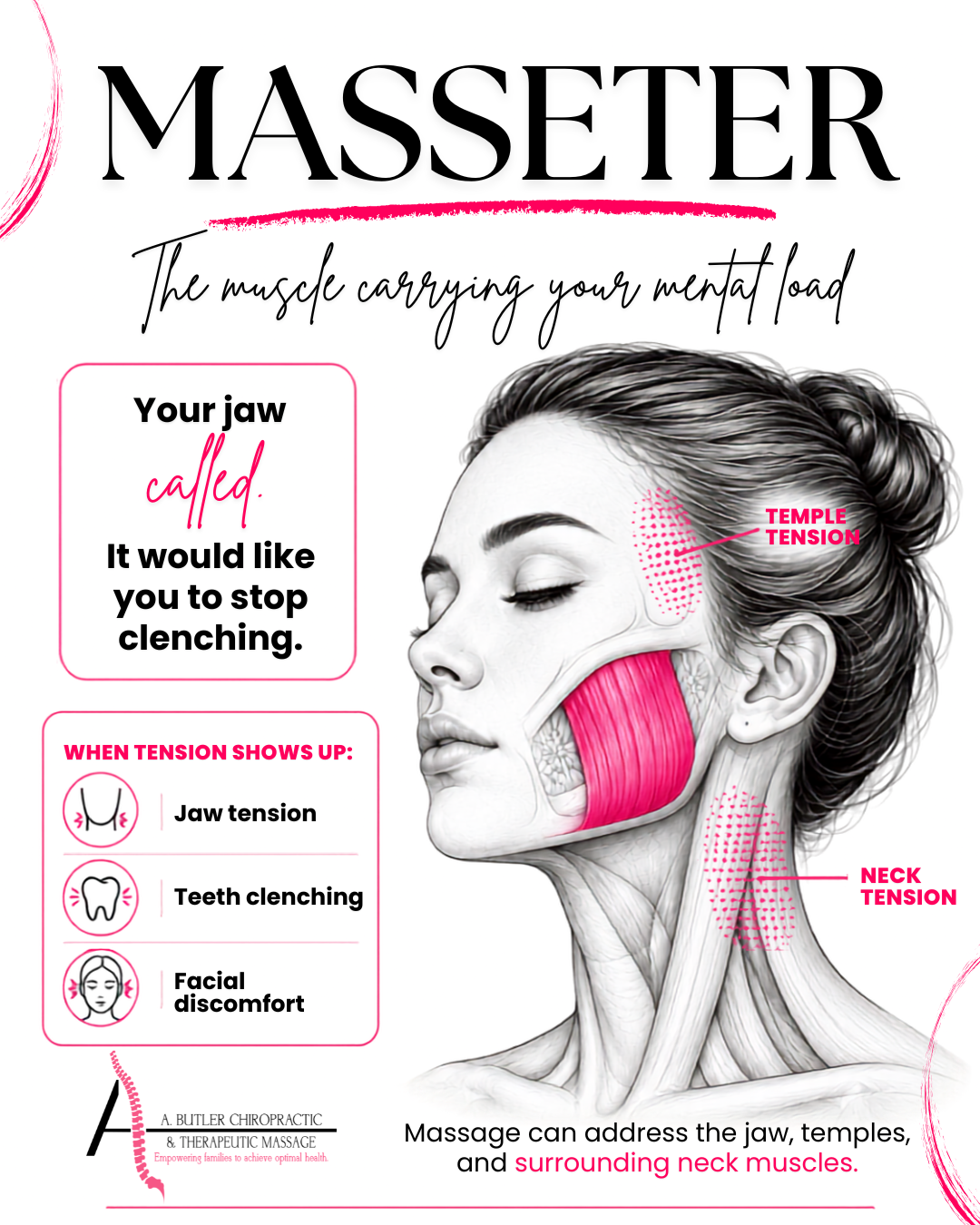
The masseter is a strong muscle located along the side of your face. It runs from the cheekbone to the lower jaw and helps close your mouth when you chew.
You use your masseter every time you bite into food, chew gum, speak, or stabilize your jaw. Because it is such a powerful muscle, it can generate a significant amount of tension when you repeatedly clench your teeth.
A tense masseter may feel firm, thick, tender, or sore when you press along the side of your jaw. Some people notice that one side feels tighter than the other. Others feel discomfort that spreads into the cheek, temple, ear area, neck, or head.
Clenching and grinding are forms of bruxism. Bruxism may happen while you are awake or asleep, and many people do not realize they are doing it. More significant bruxism can contribute to tired jaw muscles, headaches, tooth sensitivity, tooth wear, and damage to dental work.
Signs You May Be Clenching Your Jaw
Jaw tension does not always begin as sharp or intense pain. It may start as a feeling of fatigue through your face or a sense that your jaw never fully relaxes.
You might notice soreness along the side of your face when you wake up in the morning. Your temples may feel tender after a long workday. You may experience headaches that seem to begin around the jaw or sides of the head. Your neck and shoulders might also feel unusually tight, especially during stressful or demanding periods.
Other signs may include difficulty opening your mouth comfortably, pain while chewing, jaw stiffness, or painful clicking and popping. Temporomandibular disorders, commonly called TMDs, can cause pain in the chewing muscles or jaw joint, discomfort that spreads into the face or neck, stiffness, limited movement, and jaw locking.
It is also helpful to understand the difference between the terms TMJ and TMD. The temporomandibular joint, or TMJ, is the physical joint connecting your lower jaw to your skull. TMD is the broader term used for conditions affecting the joint, chewing muscles, and surrounding structures.
Not every tight jaw means you have a temporomandibular disorder. However, ongoing soreness, restricted movement, painful clicking, or recurring headaches are signs that the area may need more attention.
Why Do We Hold So Much Tension in the Jaw?
Stress is one possible contributor, but jaw clenching is not always as simple as feeling anxious.
Some people clench while they are focused. You may be typing, reading, driving, lifting weights, or completing a detailed task without realizing your teeth have been pressed together for the last twenty minutes.
Sleep-related grinding can be even harder to recognize because it happens when you are not consciously controlling the muscles. A spouse may hear grinding during the night, or your dentist may notice changes in your teeth before you experience obvious symptoms.
Your posture, breathing patterns, daily habits, sleep quality, medications, and the way your neck and jaw are moving may also be part of the overall pattern. This is why addressing jaw tension often requires looking beyond the exact spot that hurts.
How Jaw Tension Can Affect the Temples and Neck
The jaw does not function independently from the rest of the body.
Muscles around the jaw work closely with muscles through the temples, face, upper neck, and shoulders. When the masseter is constantly contracting, nearby muscles may begin helping or compensating. The temporalis muscles along the sides of your head can become overworked. Muscles through the front and back of the neck may tighten as the body attempts to stabilize the head and jaw.
Over time, you may feel as though the discomfort keeps moving. One day it feels like jaw pain. The next day it feels like a headache. Later, your neck may become stiff or your shoulders may feel as though they are living beside your ears.
Research has identified an association between temporomandibular disorders and changes involving the neck, although this relationship can be different for each person. Studies of cervical manual therapy have found potential short-term improvements in pain and jaw function for some people with TMD.
This does not mean every headache or neck problem begins in the jaw. It does mean the jaw, head, neck, and shoulders should be considered together rather than treated like completely separate parts of the body.
How Massage Therapy May Help Jaw Tension
Therapeutic massage for jaw tension is not limited to rubbing the sorest part of the cheek.
A massage therapist may work with the masseter, temples, scalp, neck, shoulders, and surrounding soft tissues based on where you are holding tension. The pressure and techniques should be adjusted to your comfort, especially because facial muscles can feel sensitive when they have been overworking.
The goal is to help reduce muscle guarding, encourage relaxation, and improve comfort through the areas supporting jaw movement. For someone who has been clenching throughout the day, simply allowing those muscles to soften can feel like a major change.
Research suggests that soft-tissue therapy and therapeutic exercise may help reduce pain and improve function for some people experiencing masseter tension and temporomandibular symptoms. Results vary, and massage is generally most useful as part of an individualized, conservative care plan rather than as a promise of a permanent cure.
At A. Butler Chiropractic & Therapeutic Massage, massage sessions are customized to the person rather than copied from the previous appointment. Your therapist can consider what your jaw, neck, shoulders, and nervous system seem to need that day.
Where Chiropractic Care May Fit
Chiropractic care may also be a helpful part of the conversation when jaw tension is accompanied by neck stiffness, restricted upper-spine movement, headaches, or muscle compensation.
The goal is not to assume that every jaw problem comes from the neck or that an adjustment will solve every form of clenching. Instead, your chiropractor can evaluate how the jaw, neck, upper spine, posture, and surrounding muscles are functioning together.
Depending on your individual findings, care may include gentle manual techniques, targeted soft-tissue work, mobility support, or recommendations to help reduce the patterns that keep overloading the area.
Manual therapy involving the neck and jaw has shown potential short-term benefits for certain people with temporomandibular discomfort, particularly when it is combined with appropriate exercises and other conservative approaches.
Sometimes massage therapy is the most appropriate place to begin. Sometimes chiropractic care is helpful. For some people, supporting both the muscles and the joints provides the most complete approach.
Small Ways to Give Your Jaw a Break
Awareness is one of the simplest places to begin.
When your jaw is resting, your upper and lower teeth generally do not need to be pressed together. Try allowing a small amount of space between them. Let your lips rest gently and allow your tongue to soften rather than pushing firmly upward.
Pay attention to what happens when you are answering emails, driving, concentrating, or feeling rushed. Those may be the moments when your jaw quietly tightens.
Slow breathing can also help you notice where you are bracing. As you exhale, think about allowing your jaw, tongue, and shoulders to soften together. The goal is not to force the jaw open or stretch it aggressively. It is simply to interrupt the habit of constantly holding tension.
During a flare, reducing gum chewing and taking a temporary break from especially hard or chewy foods may also give tired jaw muscles an opportunity to settle. Stress-management strategies, massage, movement, breathing exercises, and appropriate dental support may all be considered as part of bruxism management.
Frequently Asked Questions About Jaw Clenching
Can jaw clenching cause headaches?
It can contribute to headaches in some people. Repeated contraction of the masseter and temporalis muscles may create soreness or pressure around the temples, sides of the head, face, and neck. Bruxism is also associated with jaw fatigue and headaches.
Can massage therapy help a tight masseter muscle?
Massage therapy may help reduce muscle tension, tenderness, and guarding around the masseter, temples, neck, and shoulders. The most appropriate techniques will depend on your symptoms and whether the discomfort is primarily muscular or also involves the jaw joint.
Can chiropractic care help jaw tension?
Chiropractic care may help support neck and upper-spine mobility and address surrounding muscle tension that could be contributing to the overall pattern. Care should be individualized, and dental or medical evaluation may still be needed when symptoms involve tooth damage, significant joint dysfunction, locking, swelling, or persistent pain.
Should my teeth touch when my jaw is resting?
Your teeth do not usually need to remain pressed together when you are resting. Becoming more aware of daytime tooth contact can help some people recognize and interrupt unconscious clenching.
Do I need massage, chiropractic care, or both?
That depends on what is contributing to your symptoms. Someone with primarily muscular tension may respond well to therapeutic massage. Someone who also has neck stiffness or restricted movement may benefit from including chiropractic care. Other people may need dental support, exercises, stress-management strategies, or a combination of approaches.
Your Jaw May Be Asking for Support
Jaw clenching can become such a normal part of your day that you stop noticing it. You continue working, driving, caring for your family, and managing everything on your schedule while your jaw quietly stays braced in the background.
Eventually, those hardworking muscles may begin asking for a little support.
At A. Butler Chiropractic & Therapeutic Massage in Lyndora, we provide personalized chiropractic and therapeutic massage care for individuals and families throughout Butler, PA, Butler County, and the surrounding communities. Our goal is to look at how your muscles, joints, and everyday movement patterns are working together rather than focusing only on one sore spot.
Sometimes your body benefits most from massage therapy. Sometimes chiropractic care is the right starting point. Sometimes supporting both helps everything work together more comfortably.
To schedule an appointment, call 724-822-1828 or book online HERE.