

You're putting dishes away, reaching into the back seat of the car, drying your hair, or trying to get something off the top shelf. You can still do all of these things, but somewhere along the way, they became uncomfortable.
Then, after a long day, you finally crawl into bed, roll onto your favorite side, and there's that shoulder pain again. Apparently, even sleeping is asking too much of your shoulder these days!
This is something we see quite frequently in our office. And while there are several muscles and structures that can contribute to shoulder pain, today we're going to talk about one in particular: the supraspinatus muscle.
What Is the Supraspinatus Muscle?
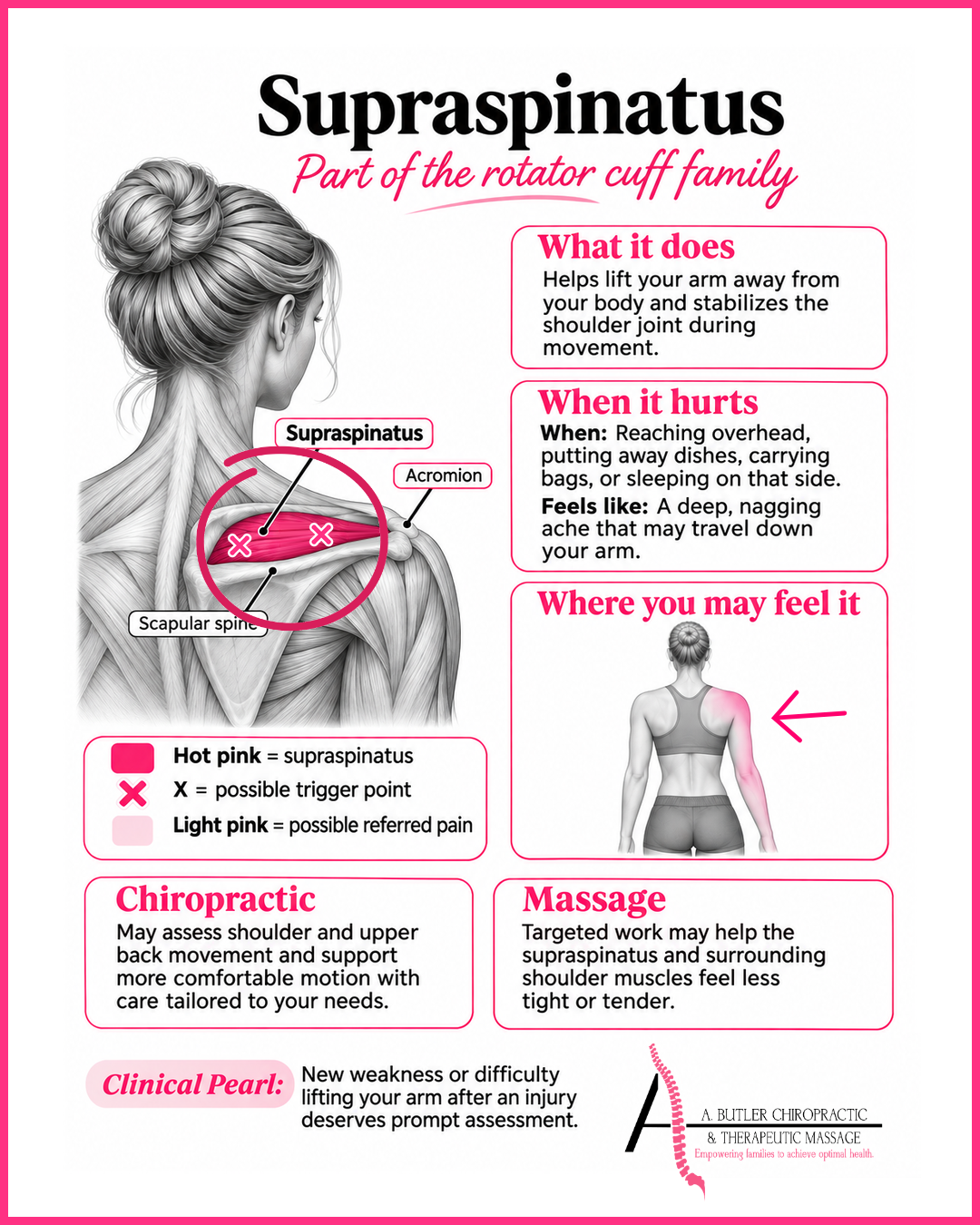
The supraspinatus is one of four muscles that make up your rotator cuff. It sits along the top of your shoulder blade, with a tendon that travels underneath the bony part of your shoulder and attaches to your upper arm bone.
Its job is to help lift your arm away from your body and keep your shoulder joint stable as you move.
It may be a relatively small muscle, but think about how many times throughout the day you lift your arm away from your body. From getting dressed in the morning to washing your hair at night, this muscle is involved in quite a bit of what you do.
And when the muscle or its tendon becomes irritated or overworked, some of those seemingly simple activities can become quite uncomfortable.
What Does Supraspinatus Pain Feel Like?
One of the more interesting things about this muscle is that where you feel the pain isn't necessarily where the problem begins.
Although the supraspinatus sits along the top of your shoulder blade, discomfort associated with it can travel into the outside of your shoulder and down the side of your upper arm.
Some common symptoms associated with rotator cuff irritation include:
A nagging ache along the outside of your shoulder or upper arm
Pain when lifting your arm out to the side
Discomfort when reaching overhead
Pain when reaching behind your back to fasten your bra or put on a jacket
Discomfort when lifting or lowering objects
Shoulder pain that wakes you up at night
A feeling of weakness when lifting your arm
Difficulty finding a comfortable sleeping position
You may experience some of these symptoms without ever feeling much discomfort around your actual shoulder blade.
This is one of the reasons we talk about referred pain so much in our office. Your symptoms give us clues about what may be going on, but we still need to evaluate the surrounding muscles and joints to better understand where the discomfort is coming from.
But I Didn't Do Anything to Hurt My Shoulder!
We hear this ALL the time.
You don't necessarily have to experience an injury to develop shoulder pain. Sometimes it's simply the accumulation of everything you've been asking your body to do.
Think about how often you're carrying children, putting groceries away, cleaning the house, exercising, gardening, or even holding a hair dryer. Individually, these activities may not seem particularly demanding. But when you're doing them repeatedly, day after day, your muscles and tendons may have difficulty keeping up.
We also see this quite a bit in our men, particularly those who work physically demanding jobs that require repetitive lifting, carrying heavy objects, or spending a significant portion of their day working with their arms overhead.
And sometimes it's not even what you're doing regularly. It might be that one weekend you decided to paint an entire room, reorganize your garage, or tackle a project your body wasn't quite prepared for.
Your body is constantly adapting to what you ask of it. Sometimes it just needs a little help keeping up.
Why Is My Shoulder Pain Worse at Night?
It's frustrating when you've managed to get through your entire day, only to have your shoulder prevent you from getting a good night's sleep.
Lying directly on an irritated shoulder can increase pressure on already sensitive tissues. But even sleeping on the opposite side can become uncomfortable if your affected arm falls forward across your body without any support.
If you're struggling with shoulder pain at night, try hugging a pillow while sleeping on your unaffected side. This gives your arm somewhere to rest rather than allowing its weight to pull on your shoulder.
If you sleep on your back, placing a small pillow underneath your elbow and forearm may also help take some of the strain off the area.
Sometimes a small adjustment to your sleeping position can make a surprising difference in how comfortable you are.
Why We Look at More Than Just Your Shoulder
If you've been a patient in our office for any length of time, you've probably heard me say this before: Muscles move bones.
Your muscles and joints work together. So when we're evaluating shoulder pain, we're interested in much more than just the shoulder joint itself.
How well is your shoulder blade moving? Is there restriction through your upper back or rib cage? Are the muscles through your chest, neck, and shoulders tight? Are other muscles working harder to compensate for the ones that aren't doing their job as well?
Your shoulder is capable of an incredible amount of movement, but there are quite a few moving parts that need to work together to make that happen comfortably.
This is why muscle work is such an important part of our approach to chiropractic care. We want to understand how the surrounding muscles and joints may be contributing to your discomfort, rather than simply focusing on the spot that hurts.
How Chiropractic Care and Massage Therapy Can Help Shoulder Pain
One of the things I love about having both chiropractors and massage therapists in our office is that we have different ways to approach the same problem.
Through chiropractic care, we can evaluate how your shoulder, shoulder blade, neck, and upper back are moving. Depending on what we find, we may incorporate adjustments, targeted muscle work, stretching, and strengthening exercises to help improve mobility and support more comfortable movement.
Through therapeutic massage, our therapists can spend more time addressing the muscles that may be contributing to your shoulder discomfort. That may include the muscles surrounding your shoulder blade, through your chest and upper back, and those that make up your rotator cuff.
And remember, therapeutic massage doesn't have to be painful to be purposeful.
You can come into our office because your shoulder hurts AND because you desperately need an hour to yourself. Your massage can be relaxing while still incorporating knowledgeable, intentional muscle work.
Our massage therapists and chiropractors can also work together when appropriate, helping your care feel a little more connected. However, you do not need to be a chiropractic patient to schedule a massage with us.
Hands-on care may help reduce discomfort and muscle tension, while appropriate exercises can help gradually rebuild the strength and function your shoulder needs.
A Few Things You Can Do at Home
While we're figuring out what's contributing to your shoulder pain, there are a few simple things you can do to help:
Temporarily reduce repetitive overhead lifting that aggravates your shoulder.
Support your arm with a pillow while sleeping.
Take breaks during activities that require your arms to be elevated for extended periods.
Keep your shoulder moving within a comfortable range rather than avoiding movement altogether.
Incorporate appropriate shoulder mobility and strengthening exercises as tolerated.
Remember, more stretching isn't always the answer. Sometimes your shoulder needs more mobility, sometimes it needs more strength, and sometimes it needs a little time to recover from everything you've been asking it to do.
Knowing the difference is important.
Just Because You CAN Do It Doesn't Mean It Should Hurt
I think this is something many of us need to be reminded of occasionally.
We become very good at adapting to discomfort. We switch which arm we use to carry things, change how we get dressed, and find a different way to sleep. Eventually, those little changes become part of our daily routine, and we forget that we didn't always have to do things that way.
You don't have to wait until you can no longer lift your arm to have someone evaluate your shoulder. If your pain is persistent, getting worse, or interfering with your sleep, it's worth looking into.
If you've experienced an injury and suddenly cannot lift your arm or notice significant weakness, seek prompt medical evaluation.
At A. Butler Chiropractic & Therapeutic Massage in Lyndora, PA, our goal isn't simply to help you hurt less. We want to help you move better, understand your body a little more, and continue doing the things you enjoy without constantly having to work around discomfort.
And wouldn't it be nice to roll over in bed without having to think about your shoulder first?
Call us at 724-822-1828 or book your chiropractic or massage therapy appointment online HERE.