
Knee Pain Isn’t Always Just the Knee: What the Muscles Above and Below It Have to Do With It
Knee pain has a way of becoming incredibly annoying, incredibly fast.
Maybe you notice it every time you go up the stairs. Maybe your knee aches after you have been sitting for a while. Maybe squatting, exercising, getting up from the floor, or simply standing up from the couch suddenly requires a little more thought than it used to.
So you stretch it.
You ice it.
You heat it.
Maybe you buy a brace and wear it for a while.
And, of course, there is always the classic approach of ignoring it and hoping your knee eventually decides to get its act together.
Sometimes those things help. But when knee pain keeps coming back, there may be more to look at than the exact spot where you feel the discomfort.
Your knee does not work by itself. It sits right in the middle of your hip and ankle, surrounded by muscles and connective tissues that influence how your entire leg moves. That is one of the reasons we take a broader approach to knee pain at A. Butler Chiropractic & Therapeutic Massage in Butler, PA. Sometimes the knee absolutely is the problem. Other times, it is one piece of a bigger movement pattern.
Why Knee Pain May Not Be Just About the Knee
Think about what happens every time you take a step.
Your hip controls and stabilizes the upper portion of your leg. Your knee bends, straightens, and manages load through the middle. Your ankle and foot adapt to the ground underneath you.
All three areas are working together.
If one part of that system is not moving or functioning as well as it normally does, another area may start compensating. That does not mean every sore knee is secretly a hip or ankle problem. It simply means that when we are trying to understand ongoing knee discomfort, it makes sense to look above and below the painful area too.
That is often why knee pain does not always respond when people only focus on the exact place that hurts. If the hip is not doing its job well, the knee may have to take on more stress. If the ankle is stiff or the foot mechanics are off, the knee may end up compensating there too.
Can Tight Muscles Cause Knee Pain?
They absolutely can be part of the conversation.
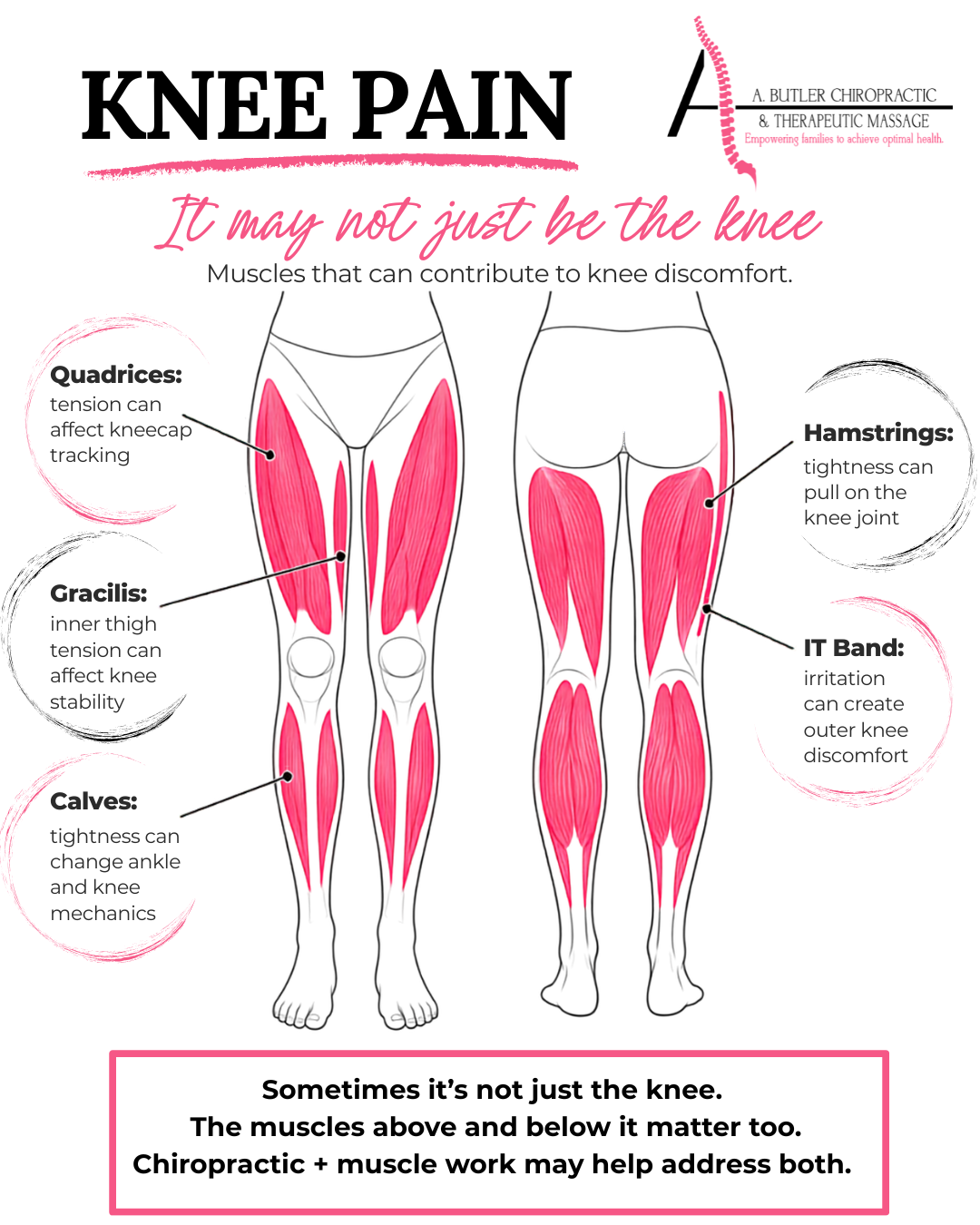
The quadriceps, located along the front of the thigh, help support the knee and influence how the kneecap moves. If they are tight, irritated, or not functioning well, they can contribute to discomfort around the front of the knee.
The hamstrings, along the back of the thigh, also cross the knee joint. Tightness here can change how the knee feels during walking, bending, squatting, or climbing stairs.
Then there are the muscles along the inner thigh, including the gracilis. These muscles help support stability through the leg, and tension there can contribute to discomfort around the inside of the knee.
Your calves matter too. A lot of people do not think about the calves when their knee hurts, but calf tightness can affect ankle motion, and ankle motion affects knee mechanics. If the ankle is not moving well, the knee often has to compensate.
And then there is the IT band along the outside of the thigh. While technically connective tissue rather than a muscle, irritation in this area can contribute to discomfort along the outer knee.
This is why repeatedly stretching the exact place that hurts does not always solve the problem. Sometimes we need to figure out what is pulling, compensating, working too hard, or not contributing enough.
What About the Kneecap?
A lot is happening around that little kneecap.
Pain around or behind the kneecap is incredibly common, especially with stairs, squatting, kneeling, exercise, or sitting with the knee bent for long periods of time. This is one reason the quadriceps are so important. They help guide and support the kneecap during movement.
When the muscles around the knee, hip, and ankle are not working together well, that can influence how the knee feels with daily activity.
That is also why saying, “My knee hurts,” is really only the beginning of the conversation.
We want to know where it hurts. We want to know whether stairs make it worse. We want to know whether sitting bothers it. Does it hurt on the inside, outside, front, or back? Does it feel stiff? Does it feel unstable? Did it start after an injury, or did it gradually begin nagging you over time?
Those details help paint a much bigger picture.
Yes, Chiropractors Can Adjust Knees Too
This surprises a lot of people, but yes, knees can be adjusted too.
Chiropractic care is not limited to the spine. Chiropractors may also assess and treat extremity joints, including the knees, ankles, feet, shoulders, elbows, and wrists, when appropriate.
A knee adjustment is not about magically “putting it back in place.” It is about assessing how the joint is moving and whether that movement may be contributing to discomfort or compensation.
That said, there is no one-size-fits-all answer for knee pain. Some people need work directly at the knee. Some need the hip or ankle addressed. Some need more muscle support. And sometimes the best next step is referral for additional evaluation.
That is why the evaluation matters so much.
Why Chiropractic and Therapeutic Massage Can Work Well Together
This is one of the reasons we love having chiropractic care and therapeutic massage under the same roof.
When someone comes into our Butler, PA chiropractic and therapeutic massage office for knee pain, we are not only thinking about the painful joint. We are also looking at the muscular patterns around it.
A chiropractic visit may focus more on joint movement and how the knee, hip, ankle, and surrounding areas are functioning together. Therapeutic massage and targeted muscle work can help address tension through the quadriceps, hamstrings, calves, hips, and other supporting structures.
Some people need more joint-focused care.
Some need more muscle work.
And plenty of people benefit from addressing both.
That is really the heart of this whole conversation: sometimes it is not just the knee. The muscles above and below it matter too.
What We Look at When Someone Comes in With Knee Pain
There is a big difference between simply asking, “Does your knee hurt?” and actually paying attention to what your body is doing.
We may look at how the knee bends and straightens, whether there is significant muscle tension, how the hips are moving, what the ankles are doing, and how your leg functions during everyday activities.
We also want to hear your story.
Did this start after gardening all weekend? After increasing your workouts? After spending more time on your feet? Did you twist something? Has it bothered you on and off for years? Are you compensating because your opposite hip, foot, or ankle hurts?
Sometimes the most helpful information comes from something you did not initially think had anything to do with your knee.
When Knee Pain Should Be Evaluated Further
Not all knee pain is appropriate for chiropractic or massage care alone.
Ligament injuries, meniscus injuries, fractures, significant arthritis, tendon injuries, inflammatory conditions, and other issues can also cause knee pain. A knee that suddenly becomes very swollen, will not support your weight, appears deformed, cannot fully bend or straighten, or is red and hot should be evaluated promptly. Severe pain after an injury should also be assessed rather than simply pushed through.
We would always rather help point you in the right direction than try to make every knee fit the same treatment plan.
If Your Knee Keeps Nagging You, It May Be Time to Look at the Whole Picture
If you have been stretching, bracing, icing, heating, and generally trying to convince your knee to cooperate without much success, it may be time to look beyond the painful spot.
Your knee is part of a bigger system. Your quadriceps, hamstrings, inner thigh muscles, calves, hips, ankles, and joint mobility can all be important pieces of the puzzle.
And yes, sometimes the knee itself may benefit from being adjusted.
If you are wondering who does extremity adjusting at A. Butler Chiropractic & Therapeutic Massage, both Dr. Amber and Dr. Jess work with knees and other extremities. Although, according to Dr. Amber’s own family, Dr. Jess apparently has the magic touch when it comes to knees.
Nothing like your own family keeping you humble.
If you have been searching for a chiropractor for knee pain in Butler, PA, or you simply want someone to take a closer look at why your knee keeps bothering you, give us a call at 724-822-1828 or book an appointment online.
Sometimes the answer is at the knee.
And sometimes we need to look a little above and below it too.